March 19, 2026 Newsletter
In This Edition:
1. From the Teacher's Lounge: Ed Tech Has Gone Too Far
2. ACTL Committee Changes
3. The Science of Math: It's Time to Act
4. Parent's Corner: Discovery's Homework Policy
5. APS Enrollment Trends and Projections
6. Happening Soon
7. Your Voice Matters Reminder
From the Teacher's Lounge:
Ed Tech Has Gone Too Far in APS Classrooms
(Editor's Note: From time to time, we will offer a perspective written by an APS parent or teacher on a topic of concern or interest for APS. What follows has been only lightly edited for clarity.)
I have been an elementary school teacher with Arlington Public Schools for nearly 20 years. I have taught as a classroom teacher and as a reading specialist. I have worked in both Title I schools and in schools with PTA budgets that would make you blush. Over these many years I have seen a lot of changes in the way we teach. Most are positive, but I believe the way we have let technology take over our classrooms is failing our students.
When I first started my career with APS as a classroom teacher, the technology we had available consisted of a heavy, precariously mounted TV and a few cassette players. When I wanted to read a book to my students I checked one out from the library or used my own money to buy it from the bookstore. I didn’t know the term “brain break” then, but when my young students started getting squirrely, we all hopped up and did jumping jacks while counting by fives or singing the alphabet. When I pulled small groups to my table, the other students worked independently. During the ELA block they read leveled books, wrote or drew responses to our read-aloud, sorted word-study cards, or listened to audiobooks on our cassette player. During Math they played games with their classmates to learn number sense, used Unifix cubes to create patterns, and used paper and pencils or whiteboards to create story problems. Was it perfect? Not at all. But the kids were learning, having fun, and staying occupied, all while building social skills and independence.
Over the years, however, the amount of technology we have allowed to creep into our classrooms has created a wildly different scene. I could cry over the number of times I have seen classroom teachers play a read-aloud from YouTube on the SMART board instead of reading a physical book to their students themselves. "Brain breaks" are almost exclusively “Go Noodle” videos that are fun and silly but often do more to rile the children up than calm them down. And what are students doing now while their teacher works with small groups? Staring at their iPads: Lexia during Language Arts and Reflex or IXL during Math.
Obviously Covid played a huge role in this dramatic shift. During this time, teachers were only able to reach students through a screen. Before the pandemic I had never heard of a teacher using a YouTube video for a read-aloud, but during online school, this really was the best way to share a book with your class (holding a picture book up to the laptop screen and reading it aloud did not work well). Before Covid, teachers didn’t utilize all the “learning apps” for independent time, partly because only the upper elementary grades had individual iPads. But when school was online, using these apps was the only way to ensure that students were engaged, because we couldn’t see them working the way we can in person.
But then this reliance on screens persisted even after we were back in the classroom, despite the research that has shown again and again that a qualified teacher provides a better and more effective learning experience than even the best app or celebrity read-aloud. Why? Well, maybe partly because teachers are human. Sometimes we look for ways to make life easier, especially when we are working in a demanding field with long hours and low compensation. We worked so hard—and quickly—in 2020 to change all of our teaching methods to be iPad-accessible, and then we never had the time or energy to go back.
But this is also a problem that APS created. Up until just this year, APS continued the 1:1 iPad policy for all elementary students that had started in 2020. Around this time, APS bought a contract for Lexia but then continued to push it on teachers well after we were fully back in school. Teachers were even told by central office that students were required to spend a specific number of minutes on Lexia each week and that they would be monitoring usage--teachers whose minutes weren’t where they should be were brought to the attention of their school administrators. (This school year is the first year the ELA office has not sent out that message, but neither have they sent a message saying we are no longer using Lexia or what to do instead.) The reading curriculum that the county adopted a few years ago (CKLA) has a daily read-aloud component. But embedded in the slide deck that every teacher uses is a hyperlink to a recorded version of the read-aloud. Why are we provided this option?
I have always been proud to work for APS because it is a school district that is progressive and responsive and works hard to improve the lives of all of its students. I know that APS is starting to see the downside to the amount of technology we have in our classrooms. This year, for example, APS completely eliminated iPad use in Kindergarten and reduced the number of iPads in first grade classrooms. But this is not enough. APS needs to continue this push across grade levels. The option to play read-alouds from the SMART board needs to be eliminated. It is time to say goodbye to Lexia and so many other learning apps that just aren’t necessary. And can we please have “brain breaks” that focus on body movement and skills instead of flashing lights and blaring music?
This will no doubt be a huge adjustment for teachers who have leaned on these tools over the last six years, but I have full confidence that we can do it! Arlington teachers are masters at changing and growing to provide the best educational experience—we shifted our entire way of teaching reading (from Balanced Literacy to Science of Reading) just a few years ago, before any other school district in the area. APS can help make the transition smoother with resources and professional development and extra time to plan. But the fact that it might be hard is not a reason to avoid it. Our students' futures depend on it.
Note from the author: I chose to write this piece anonymously because I did not want anyone to think that the problems I am describing are confined to my current place of employment. I have seen these same problems at many schools and heard about them from friends and colleagues across Arlington and in other school districts. I am not some luddite who believes technology is inherently evil. I use my SMART board every day to teach small-group phonics lessons in a much quicker and more efficient way than if I were using a whiteboard. I also recognize that assistive technology has made learning possible for so many students. Hopefully it is clear that I am not arguing for a technology-free school system, but a smarter approach to our technology use.
Served on an ACTL Committee? Tell the Board Your Thoughts on Standing Subcommittees
Last week, the School Board discussed proposed changes to APS’s Policy on Advisory Committees. (Policy, Summary) The proposed Policy calls for some ACTL standing subcommittees to be retained. However, there was member debate as to whether that language should be taken out, which would effectively turn all ACTL subcommittees into ad-hoc committees that would only meet as needed going forward.
While not well known, the ACTL subcommittees were a driving force behind numerous APS policy successes, including the adoption of Science of Reading and Middle School intensified courses. The Board is scheduled to vote on the new Advisory Councils Policy at their March 26 meeting. If you have views on retaining ACTL standing subcommittees in their current form, let the Board know!
Email the School Board your thoughts.
The Science of Math:
It's Time for APS to Act
What’s happening: At its March 24 work session, the School Board will discuss math instruction and the Science of Learning. Arlington Public Schools (APS) has already applied these principles to reading, replacing Lucy Calkins’ balanced literacy approach with the Science of Reading. It’s time to bring the same shift to math.
The big picture: The Science of Learning shows that students need a strong base of knowledge before they can tackle complex problem-solving.
• In reading, that means Decoding (phonics) × Knowledge (content, vocabulary) = Strong reading comprehension
• In math, it means automatic recall of math facts and procedural fluency.
What the research says: Evidence-based instruction emphasizes explicit teaching, worked examples and guided practice. Cognitive science research shows that novice learners perform better with explicit instruction because it reduces demands on working memory and helps build durable knowledge in long‑term memory. Inquiry-based learning still has a role—but timing matters. Exploration works best after students have built foundational knowledge. Used too early, inquiry approaches can lead to cognitive overload, frustration and weaker learning outcomes.
Why it matters for equity: Explicit instruction produces especially strong gains for English learners, students with disabilities, and struggling students. Research shows it is one of the most effective ways to reduce achievement gaps. The U.S. Department of Education’s What Works Clearinghouse recommendations for struggling elementary math students emphasize systematic instruction and frequent, timed practice of math facts—approaches that align closely with the Science of Learning.
Bottom line: APS SOL math scores remain below where they should be. Aligning math instruction with the Science of Learning would bring APS in line with the strongest available evidence. APS deserves credit for beginning this conversation. The next step is putting these research-based practices into place.
Parent's Corner:
Discovery Elementary's Homework Model Builds Executive Function and Equity
(Editor's Note: From time to time, we will offer a perspective written by an APS parent or teacher on a topic of concern or interest for APS. What follows has been only lightly edited for clarity.)
APS should look to Discovery Elementary’s recently-added homework policy as a model for all of its elementary schools. Having started at the beginning of the 2024-25 school year, this structured homework program in 3rd, 4th, and 5th grades—focused on the core subjects English and Math—is playing an important role in better preparing Discovery students for the expectations of middle school while also advancing equity.
Homework reinforces learning, with students at these ages developmentally ready to begin taking greater responsibility for their learning. These short, well-designed weekly assignments in English and Math allow students to practice foundational skills outside of school—such as reading comprehension, writing, and arithmetic—that improve with repetition (especially Math). This practice helps solidify what students learned in class and identifies areas where they may need additional support.
Discovery’s homework program is also furthering equity. APS families with greater resources often supplement classroom instruction with workbooks, tutoring, or enrichment activities at home, which was happening with many Discovery parents before this new policy. Discovery’s school-provided homework ensures that all students have access to extra practice and skill-building, regardless of their family’s time, knowledge, or financial resources. Notably, Discovery’s homework is not graded.
Another important benefit is the development of executive functioning skills. When students are expected to complete assignments outside the classroom, they learn how to plan their time, keep track of tasks, and follow through on commitments. These habits—organizing materials, remembering due dates, and pacing work over several days—are foundational skills that middle school teachers expect students to have.
Introducing these expectations gradually in upper elementary grades allows Discovery students to build those skills in a supportive environment rather than facing a sudden shift, which students from a number of other APS elementary schools face in 6th grade. The development of these skills helps students in their non-academic lives too.
Lastly, Discovery’s new homework policy is budget neutral. For this additional weekly homework, Discovery uses otherwise unused parts of its CKLA English curriculum and its never-before-used EnVision Math workbooks.
With Discovery’s thoughtfully designed and appropriately-sized homework policy, Discovery is not simply handing out busy work to kids. It is a tool helping Discovery students strengthen academic skills, develop independence, and build the organizational habits they will need to succeed in middle school and beyond.
APS Enrollment Continues to Edge Down
The big picture: Following on last year’s declines, APS K-12 enrollment continues to edge lower in SY 2025-26. Numerous factors are likely playing a role, including the backdrop of a) declining Arlington births and b) rising housing costs, which leads some families to move out of the county.
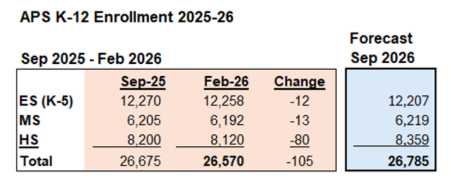
Why it matters: APS had a sizeable miss of 2.8% in its K-12 enrollment projections for September 2025, when 779 fewer students were enrolled than APS projected in Fall 2024. This shortfall necessitated a rebalancing of classes this past fall. APS enrollment is presently down 215 students relative to its current projection for September 2026. The backdrop of factors behind last year’s unexpected enrollment drop continues to exist today.
Pre-K: APS has also over projected PK enrollment by 200-365 students over the last several years. For September 2026, APS projects 173 more PK students than last year excluding dual enrollees. After years of successive PK enrollment overestimation, it is not clear why APS continues to follow this approach. This procedure leads APS to consistently overestimate Pre-K budget allocations, reducing flexibility to make deliberate, needs-based investments elsewhere in the system.
Bottom line: APS needs to have accurate projections and budget planning to ensure proper planning for facilities, courses and staffing.
Happening Soon
Thursday, March 19, 7:00 PM – School Board Meeting. Syphax. Sign up to speak · Watch live
Tuesday, March 24, 7:00–9:00 PM – ASEAC Meeting. Location TBA. More information
Wednesday, April 1, 7:00–8:30 PM – ACTL Meeting. Syphax Building, Rooms 452/454/456. More information
Thursday, April 2, 7:00 PM – School Board Meeting. Syphax. Sign up to speak · Watch live
Don’t forget! You can subscribe to APS School Calendars!
Request From APS - Reminder to Complete Your Voice Matters Survey
APS has asked us to encourage all APS families, who have not already done so, to complete the Your Voice Matters (YVM) Survey. The survey closes this Fri, March 20 at 11:59 pm. The feedback families provide helps APS identify areas for improvement and informs decisions that aim to strengthen family engagement and supports for all students.
If you have not already participated, please take a few minutes to share your feedback. Take the family survey here.