April 21, 2026 Newsletter
In This Edition:
1. From the Teacher's Lounge: Ed Tech Has Gone Too Far
2. ACTL Committee Changes
3. The Science of Math: It's Time to Act
4. Parent's Corner: Discovery's Homework Policy
5. APS Enrollment Trends and Projections
6. Happening Soon
7. Your Voice Matters Reminder
Partial School Weeks Dominate the APS Calendar:
65% of School Weeks Are Shorter than 5 Days,
Only 35% Are Full Five-Day Weeks
APS’ own attendance policy highlights that “missing just two days a month can negatively impact learning,” yet the district’s calendars routinely miss multiple days of instruction per month. Instructional days are reduced during formal calendar planning, and even more are lost during the year, when APS adds closure days (i.e. the recent decision to close schools during a special election on April 21st).
The big picture
This year Arlington Public Schools only have 15 full five-day weeks (using elementary as the baseline) between the beginning of the school year to the end of the school year (43 weeks). That means only 35 percent of APS’ school weeks are full five-day weeks.
From September 19 to November 17 APS students went nearly two full months without a single five-day week, just as students were trying to settle into their new routines and learn.
The background
This fragmentation has resulted from an increasing number of early release days and closure days, whether they are professional development days, cultural and religious holidays, or teacher workdays. Since 2023, early release days have increased 320%, from 5 to 16, and the number of closure days averages 34. This year has the most days off of any school year we can find on record: 36 days.
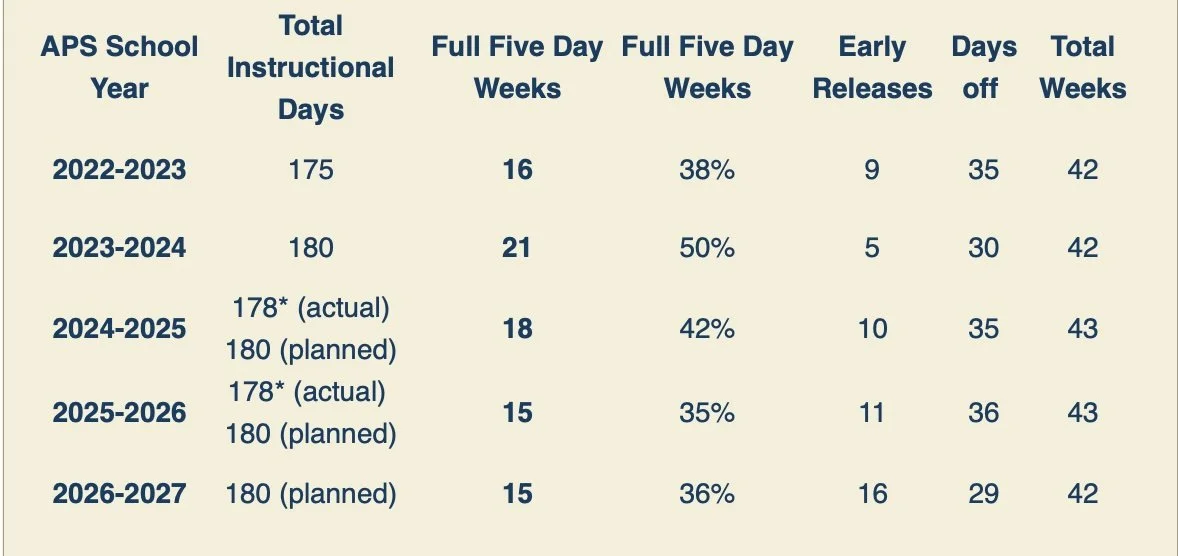
*Actual: In the past two years APS has repeatedly removed instructional days from the school year calendar during the school year, separate and apart from weather days (see footnote).
Full Five Day Week does not have an Early Release or a day off of school.
Days Off count includes Winter and Spring Break.
When the calendar contradicts the message
APS’ recent system-wide message that “Attendance Matters as the School Year Ends” and that “Every day between now and the end of the year counts” felt incongruent with the reality many families are experiencing—not because families disagree in principle, but because the calendar itself tells a different story. This message arrived between two 4-day weeks (one week is actually 3.5 days long for high-schoolers), one of which was added with relatively short notice last month. In a school year where only about 35 percent of weeks are full five-day instructional weeks, families are navigating a schedule that is frequently interrupted and difficult to predict. Parents report concern about their ability to maintain employment with an erratic school schedule, a burden which falls particularly hard on women.
Why it matters
Consistency matters, especially for younger students, whose instructional momentum and classroom routines are harder to sustain amid frequent breaks. Even short disruptions introduce transition costs—time spent re-establishing expectations, re-engaging students and reviewing prior material. For students of all ages, when the calendar itself reduces instructional time and creates repeated disruptions, it undercuts the very message being communicated by APS. If every day truly counts, the structure of the school calendar should reflect that priority.
An effective education system prioritizes consistency and continuity which enables instruction to build on itself, rather than fragmented segments which require repeated resets. Teachers and students need consistency and predictability to develop the routines, trust, and behaviors that enable them to focus on instruction and learning. Without a reliable schedule, teachers and students spend all their time trying to establish routines and never settle into deep learning.
Research suggests that frequently starting and stopping instruction can be detrimental to learning: more fragmented school calendars are associated with lower student achievement (Jennifer Graves, 2010; 2011) and disruptions to instructional continuity reduce learning effectiveness by increasing time spent on review and re-engagement (National Bureau of Economic Research Working Paper No. 29979). While a single day off may seem minor, repeated disruptions create compounded effects over time.
The equity impact
Additionally, consistency in the school calendar helps families and students across the County, especially low-income families. Employers expect employees to be at work five days a week. Parents of school-age children in Arlington County can only do that for 35 percent of the year via their public school system.
FCPS School Board Member Melanie Meren recently stated that “Partial school weeks function as an informal ‘childcare tax’ that falls hardest on our hourly-wage and most vulnerable households.” The same dynamic applies to vulnerable families in Arlington.
As APS School Board Member Zuraya Tapia-Hadley stated at the March 26th School Board meeting, regarding the vote to remove April 21st as a day of school, “Parents who do not have the luxury of being able to afford quality childcare, especially for young children, are at the forefront for me. These are families who don’t have the time or resources to be here with us, to attend PTA meetings, and who are working two or three jobs. That’s who I feel beholden to. I am confident that we can find a safe way to ensure our children receive the education they are due.”
FCPS Board Member Mateo Dunne added,“for students from low-income families, the harm [from fragmented school calendars] is compounded. School is not merely a place of academic instruction, it is also a reliable source of meals, adult supervision, mental health support, and a structured daily routine. Every truncated week removes access to these critical resources.”
FCPS has already begun addressing the issue. In April, Fairfax County Public Schools voted to make Veteran’s’ Day an instructional day and to cap the number of early releases to eight. APS, by contrast, has 16 early release days planned for next school year. In March, FCPS changed two early release days to full instructional days after FCPS decided to close on April 21st.
Bottom line
This isn’t about one day off or one early release day. It’s about a calendar where fragmentation is the norm, not the exception, and where the lack of consistent five-day weeks has become a defining feature of the school year.
If continuity and attendance in school matters for learning—as APS states—then the current structure is working against learning. APS should revise its calendars and policies so they truly prioritize consistent instructional time and deliver a consistent education.
Want a more consistent school calendar with more full weeks? Email the School Board
Footnote:
APS School Board voted in March 2026 to remove April 21, 2026 as an instructional day because of a state-wide special election.
APS School Board voted in November 2025 to remove March 13, 2026 as an instructional day for elementary and middle school students to give more time for parent-teacher conferences in March 2026. An early release on April 22nd was changed to full day for elementary and middle.
APS School Board voted in May 2025 against removing Friday, June 6 as an instructional day after Muslim leaders told APS Eid would be celebrated on Friday instead of Saturday. This would have brought actual days to 177.
APS School Board voted in November 2024 to remove two instructional days (November 4, 2024 and January 30, 2025) to enable professional learning.
Happening Soon
Tuesday, April 21, All Day – NEW: No School for Students – Countywide Professional Learning for Staff
Sunday, April 26, 5:30 PM-7:00 PM - Raising Tech-Wise Kids: AI, Tech & Mental Health. Columbia Falls Church. Tickets
Tuesday, April 28, 6:30 PM–8:30 PM – School Board Work Session with BAC. Syphax. Watch live. Agenda/Materials.
Tuesday, April 28, 7:00 PM-9:00 PM – ASEAC Meeting. Syphax 454/456. Registration.
Thursday, April 30, 7:00 PM – School Board Meeting. Syphax. Sign up to speak. Watch live. Agenda/Materials.
Don’t forget! You can subscribe to APS School Calendars!