January 28, 2026 Newsletter
In This Edition:
1. Virginia Changes to SOL Testing
2. Disproportionate Rate Disabled Students Suspended at APS
3. Parent Tip: High School Pathways and College Credit
4. Virginia Tightening School Phone Policy
5. New Virginia K-12 Leadership Announced
6. School Board Meeting Recap
7. Happening Soon
Virginia Changes SOL Testing:
What's Changing, When It Starts, and Why
Why It Matters:
Virginia lawmakers passed legislation in 2025 that changes when SOL tests are given, how scores are reported, and whether they count toward course grades. These changes will reshape middle and high school academic calendars starting in 2026-27.
What Passed:
House Bill 1957 (2025 Regular Session) was introduced by Delegate Dan Helmer (D) as the primary sponsor, with Senator Schuyler VanValkenburg (D) listed as a cosponsor. The bill passed both chambers of the General Assembly directing the Virginia Department of Education and the Board of Education to overhaul key aspects of SOL testing.
The legislation was developed in response to long-standing concerns about:
SOL testing occurring too early in the academic year,
Loss of instructional time due to extended testing windows, and
The perceived disconnect between SOL results and classroom performance.
When It Takes Effect:
All major, student-facing provisions take effect beginning with the 2026-27 school year. The 2025-26 school year serves as a transition and preparation year for school divisions to adjust schedules and grading systems.
What’s Changing
For applicable courses in grades 7-12:
1. SOLs will count toward course grades and serve as final exams
SOL scores must count for at least 10% of the student’s final course grade, per the bill sponsor, and no other final exam may be given. VanValenburg explained in a recent interview: "He said the primary goal is to reduce overtesting by replacing separate teacher-led finals with standardized end-of-course exams, ensuring students face only one major cumulative test."
Students may retake an SOL, but only the first attempt counts toward the course grade.
Note: new identical bills from Helmer and VanValkenburg propose delaying these provisions until the new testing system is in effect several years from now.
2. Testing moves to the end of the school year
SOL end-of-course tests must be administered during the final two weeks of the school year.
Elementary SOLs (grades 3-6) are not included in the grading requirement, and therefore are not included in the mandated end-of-year testing window.
For all applicable courses in grades 3-12:
1. New scoring scale
SOLs will move from a 600-point scale to a more intuitive 100-point scale, aligning results more closely with classroom grading systems.
Outside of these mandated changes in the bill, cut scores for Math and Reading will be rising to levels consistent with NAEP (the nation’s report card), phased in over the next 3 school years.
2. Test scores must be released within 45 days after the closing of the testing window for a given test
What We’re Watching:
With SOL testing moving later in the year, we will be advocating with the state and APS for the transparent and timely release of results to a) give families practical insight into student learning and b) provide clear, comparable data which will help identify system-level trends and achievement gaps.
APS Data Reveal Disproportionately Large Rate of Suspension for Students with Disabilities
The Data:
Students with disabilities (SWDs) in Arlington Public Schools continue to be suspended at disproportionately high rates. While SWDs make up 15.4% of the APS student population, they accounted for 45.5% of all out-of-school suspensions during the first quarter of the 2025–26 school year, according to data presented to the School Board on November 13, 2025.
1. Out-of-School Suspension Rates, All Grades
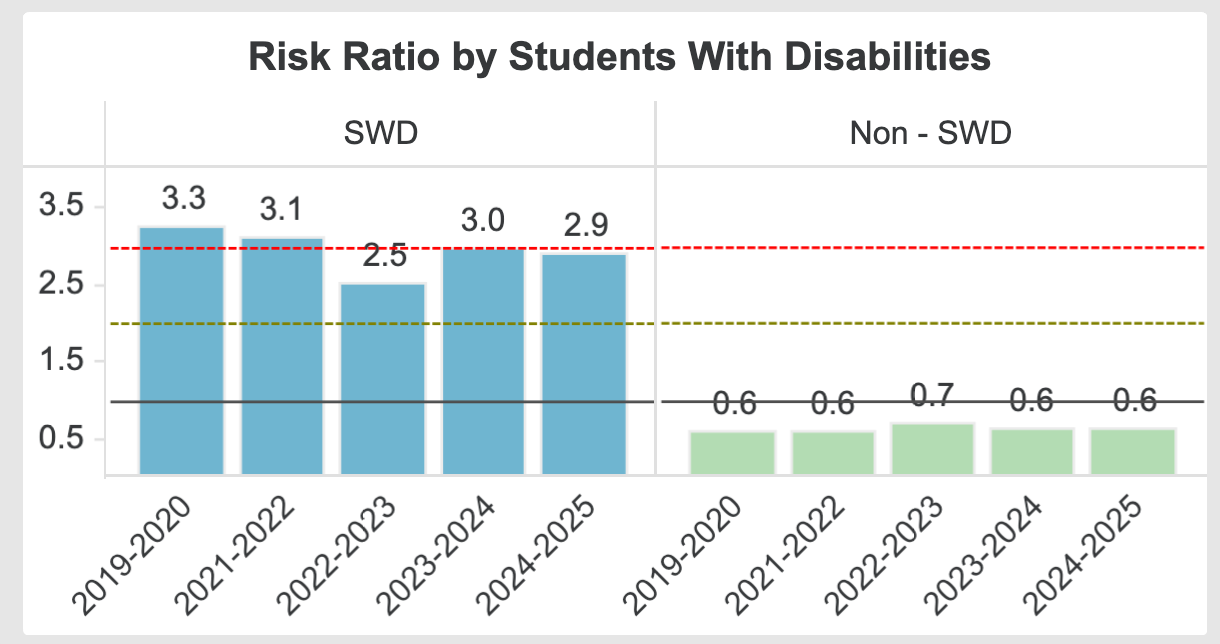
High Risk: Red line Moderate Risk: Green line Low Risk: Black line
Source: APS Data Dashboard, Out-of-School Suspensions, All Grades
The problem is worse for elementary aged SWDs who are nearly seven times more likely to be suspended than their non-disabled peers. In 2024-2025, SWDs accounted for 67% of out-of-school suspensions despite making up only 16.7% of the elementary population.
1. Out-of-School Suspension Rates, Elementary Students Only
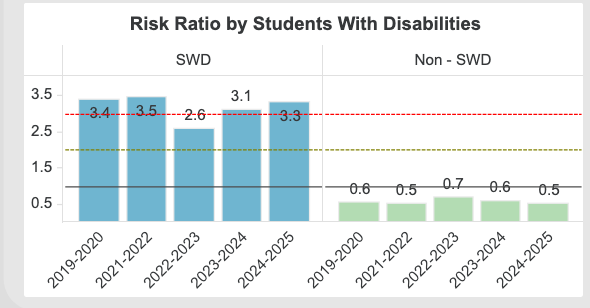
High Risk: Red line Moderate Risk: Green line Low Risk: Black line
Source: APS Data Dashboard, Elementary Out-of-School Suspensions
Why ASEAC Raised Concern:
In May 2024, the Arlington Special Education Advisory Committee (ASEAC) formally raised concerns about these disparities, emphasizing not only high suspension rates but also the use of “informal removals.” ASEAC warned that practices such as sending students home early or asking parents to keep children home deny students access to instruction while avoiding formal suspension reporting, data tracking and procedural safeguards.
“This ‘informal removal’ is not tracked or accounted for as a formal suspension—despite the child not being able to access their education,” ASEAC wrote, noting that the practice is counter to state law.
ASEAC highlighted that these removals disproportionately affect students whose disabilities manifest through dysregulation or behavioral challenges, including students with autism, intellectual disabilities and genetic disabilities.
Why This Matters:
Federal law under the Individuals with Disabilities Education Act (IDEA) requires that students with disabilities receive IEPs that include appropriate behavioral supports and are “reasonably calculated” to allow meaningful educational progress. ASEAC expressed particular concern about the extreme disproportionality at the elementary level, where early intervention is most effective and long-term educational trajectories are shaped.
ASEAC noted that the frequent use of suspensions and “informal removals” for students with disabilities may reflect:
Insufficient or inadequately implemented behavioral supports within IEPs, particularly for students whose disabilities manifest through dysregulation or behavioral challenges
Staffing shortages or training gaps, limiting schools’ ability to respond to disability-related behaviors with evidence-based interventions rather than removal from instruction
Inconsistent understanding or application of special education discipline protections, especially at the elementary level
Practices that may conflict with Virginia regulations and IDEA requirements, particularly when informal removals are used in place of documented disciplinary actions
Additionally, these disproportionate rates of suspensions may indicate that:
APS is not creating IEPs that are “reasonably calculated” to provide proper behavioral supports for disabled students.
APS lacks staffing to provide adequate supports.
Staff are not properly trained to support disabled students with behavioral issues.
There is systemic bias against disabled students.
According to advocacy groups for disabled students, the short and long-term implications of removing disabled students from school is especially harmful, including decreased performance, school rejection, higher absenteeism and lower graduation rates, as well as having a significant impact on parents.
Get Involved
Share your experience by emailing us.
Join monthly ASEAC meetings provide an opportunity for parents to advocate for disabled students.
ASEAC meeting is on February 17th at 7pm. You can attend in-person or virtually.
What I Wish I'd Known for my College Freshman:
High School Pathways and College Credit
Written by a parent of an APS graduate
If you’ve been reading our newsletter, you’ve probably seen our “From the Teacher’s Lounge” and “Parent’s Corner” features. These are thoughtful reflections from staff and families who want to share their stories, insights or even just a perspective from their day-to-day...our community’s own version of an op-ed!
We’re excited to begin sharing a new edition of these pieces here as well focused on tips and tricks from other parents (or educators!). We hope this space is a welcoming forum where voices from across our community can spark ideas, encourage dialogue and build connection. And if you’ve ever thought about contributing your own piece, consider this your invitation. We’d love to hear from you!
As a parent navigating the high school-to-college transition, I’ve learned a lot—most of it the hard way. If you're just getting started on this path or already deep into it, I hope this helps you avoid some of the frustrations and financial surprises we faced.
1. IB vs. AP: College Credit Realities
Let’s start with the biggest lesson: IB generally stinks for college credit. While the International Baccalaureate (IB) program offers a challenging curriculum, it’s nowhere near as effective as AP when it comes to earning college credit—especially in the U.S.
AP classes give students direct access to college credit through standardized exams. Many universities have well-established policies for granting credit for AP scores. IB credit is often inconsistent, limited, or doesn’t apply to core requirements. For example, college credit for IB classes is often limited to the higher (‘HL’) version of the IB class. Meanwhile, the lower (‘SL’) version is still very rigorous, and is often the only version of a class offered (for example, IB Economics at Washington-Liberty HS–W&L–is only the ‘SL’ version which doesn’t provide college credit at most colleges).
Our son went to W&L, which offers the IB program. That limited his access to the much broader range of AP courses offered at other local schools like Yorktown. While there are many things I loved about the IB curriculum at W&L (the emphasis on writing, for example), I wish I had understood how much more difficult it is to get college credit for IB classes, and how to structure my child’s coursework to maximize his ability to get college credit for the IB classes he did take. This is something that would be helpful for APS to explain to parents when their kids are in 8th grade and deciding on high school coursework.
2. You Can Take AP Exams Even If You Didn’t Take the AP Class
This is something I really wish I had known earlier: students can take AP exams even if their school only offers IB courses.
For example, our son took IB Economics his Junior year (which covers micro and macroeconomics), but W&L doesn’t offer AP Micro- or Macro Economics. What we didn’t realize—until it was too late—is that he could still register for the AP Micro and Macro exams at the end of the year.
He ended up taking the AP Microeconomics exam his senior year (they only offer the opportunity every other year with Macro in-between), scored well, and placed out of college Micro—a required course for his business major at a large out-of-state school.
But he missed the chance to take AP Macro exam at the end of his junior year, meaning he’s now stuck taking it in college—paying time and money unnecessarily. That’s a mistake we could have avoided with better information.
Be aware that you will need to reach out to APS and request your child be enrolled for the AP exam and pay the out of pocket expense (roughly $100). If your child takes the AP course through APS, APS will automatically enroll your child in the AP exam and pay for it. But if your child doesn’t take the AP course, you’ll need to be proactive about getting your child enrolled and paying for it. You can also find curriculum and study guides online your child can use to study for the AP exam.
3. Math Pathways Matter More Than APS Lets On
Our son was accelerated in math and took AP Calculus in his junior year and AP Statistics in his senior year. APS has rationalized decelerating math students because its data showed that very few of the accelerated kids took the "most rigorous path", which would be multivariable calculus, by senior year. It seems APS didn’t see value in accelerating kids in math unless they pursued the most rigorous possible pathway. I find this logic strange.
Because, here's the thing: he got college credit for both AP Calculus and AP Statistics—and both are required for his business major. Now, because he earned those credits in high school, he’s on track to graduate a semester (or even a full year) early.
That’s a huge financial and time win—thousands of dollars saved in tuition, housing, and fees. And yet, APS has actively discouraged this route for some students, pushing instead for a decelerated pathway that wouldn’t necessarily offer the same financial (nor academic) benefits.
I believe this lack of transparency hits hardest for high-achieving, lower-income students. They may not know that they can earn these credits in high school—or that earning them early can significantly reduce the cost and time-investment of college. I’m not sure why APS is not sharing this information with parents so they can make the best, most informed decision before it’s too late.
4. Take Control—Don’t Wait for the School to Tell You
Perhaps the most important advice I can give is this: be proactive. Don’t assume the school will tell you all your options. They won’t—or if they do, it may be too late.
Research AP exam policies at your student’s prospective colleges. Look into dual enrollment, CLEP tests, AP self-study, and any other credit-earning opportunities. Talk to other parents, visit college websites, and stay ahead of the timeline.
Because what you don’t know can cost you—and not just money, but time, stress, and opportunity.
Virginia May Tighten Student Phone Rules,
Putting Arlington's Policy in Focus
Why It Matters:
Virginia lawmakers are moving to close a loophole in the state’s student cellphone law after districts, including Arlington Public Schools (APS) and Fairfax Public Schools (FCPS), adopted policies that allow limited device usage during the school day.
The Backdrop:
In 2025, the General Assembly passed HB 1961 / SB 738, now codified in Va. Code § 22.1-79.3:1, requiring school boards to restrict student access to cellphones and smartwatches during the school day. The law treats phones and smartwatches the same: "Except as provided in subdivision 4, restrict student cell phone and smart device possession and use on school property from bell to bell".
Where Arlington Stands:
APS Policy J-6.3.13 and its Policy Implementation Procedure (PIP) require devices to be “off and away,” but allow:
Smartwatches to be worn
Limited use during lunch
That structure relies on the statute’s use of the word restrict, rather than prohibit.
What’s Changing:
Senate Bill 108 (SB 108) would amend current law to prohibit rather than just “restrict” student possession and use of both cellphones and smart devices during school hours, eliminating lunch-period or smartwatch exceptions. The bill passed unanimously out of the Senate Education and Health Committee last week and was unanimously approved by the full Senate yesterday, clearing its chamber of origin. It will now be transmitted to the House of Delegates for consideration.
Why It’s Debated:
Critics, including as the bill’s sponsor, Senator Stella Pekarsky, a former School Board member for Fairfax County Public Schools, say lunch exceptions undercut the law’s intent, noting that lunch occurs during “regular school hours” and that phone use can spill over from there into classrooms. They argue that the state had aimed for consistency, not district-by-district interpretations.
District leaders counter that local flexibility allows schools to balance enforcement with student autonomy and operational realities.
Bottom Line:
If the bill passes, APS would likely need to revise Policy J-6.3.13 and its PIP to fully prohibit student device use during the school day, aligning local practice with a uniform statewide standard.
New Virginia K-12 Leadership Announced
Gov. Abigail Spanberger announced two senior appointments to lead Virginia’s K-12 education agenda, naming former Hamptons City Superintendent Jeffrey O. Smith to be the next Virginia Secretary of State and appointing Jenna Conway to be the next State Superintendent. Conway is currently the chief of early learning and specialized populations at the Virginia Department of Education.
What They're Saying:
The appointments align with Governor Spanberger’s Strengthening Virginia Schools plan, announced in August 2025, which emphasized academic rigor and student outcomes. In announcing Smith’s appointment, the Governor said, “Dr. Jeffery O. Smith is an educator who has more than 32 years of service in public-school education… Under his leadership, Hampton City Schools reached historic milestones: for the first time, all 29 schools earned full accreditation without conditions, graduation rates rose from 88% to nearly 98%, and dropout rates declined from 5.1% to less than 1%.”
On Conway’s appointment, the Governor stated, “Over the past seven years, Conway has spearheaded Virginia’s efforts to strengthen its birth-to-five early childhood care and education system, ensuring every child is prepared for kindergarten and beyond.” Her portfolio also includes special education, behavioral health, student safety, and adult education.
Between the Lines:
Together, the appointments reflect a pairing of district-level operational experience and statewide policy leadership. Smith has described his approach as rooted in sustained improvement, noting that “we have worked to build from places of strength and embraced the fact that there are no shortcuts to excellence.” Conway brings a nontraditional background to the role, with degrees from Yale University and Stanford Graduate School of Business and prior private-sector experience before entering public service in 2010.
Top Four Takeaways from the
Jan 22nd, 2026 School Board Meeting
Top Takeaways — January 22, 2026 School Board Meeting
Public Comment Focused on Grace Hopper and Technology Use - Speakers raised concerns about the Grace Hopper Center proposal and broader issues related to student device use and instructional balance.
Staffing and Workforce Challenges Discussed - The Board reviewed a Human Resources' update addressing recruitment, retention, and ongoing staffing pressures across APS.
Secondary Pathways and Program Planning - Staff presented updates on secondary academic pathways, including how the Grace Hopper Center is intended to expand career and technical education options.
Implementation Details Still in Development - Board members asked clarifying questions about timelines, program structure, and community engagement, with several elements of the Grace Hopper plan still under refinement.
Read the full recap here.
Happening Now
Monday, February 2, 8:00 AM – Audit Committee Meeting. Syphax Education Center, School Board Conference Room (Suite 260).
Wednesday, February 4, 7:00–8:30 PM – ACTL Meeting. Syphax Building, Rooms 452/454/456. ACTL information
Thursday, February 5, 7:00 PM – School Board Meeting. Syphax. Sign up to speak · Watch live
Tuesday, February 10, 6:30 PM – School Board Work Session (ACTL). Syphax. Watch live
Thursday, February 19, 7:00 PM – School Board Meeting. Syphax. Sign up to speak · Watch live
Friday, February 27, 8:00 AM – Audit Committee Meeting.Syphax Education Center, School Board Conference Room (Suite 260).