
October 23, 2025 School Board Meeting
Opening
The meeting opened with the presentation of colors by the Arlington Career Center Space Force JROTC cadet corps, followed by the Pledge of Allegiance.
The Board recognized Safety and Emergency Management Week (October 27-31), highlighting the Office of Safety, Security, and Emergency Management's efforts in planning, training, and family communication to build a safety culture. It urged families to review emergency procedures.
Consent Agenda Adoption
The Board unanimously adopted the consent agenda, approving new staff hires, revisions to policy J-83830 (Food and Nutrition Services, addressing unpaid meal charges) and new policy D-2.37 (Financial Management, other post-employment benefits fund), and a climate action resolution. The resolution commits APS to sustainability goals, including transitioning to renewable energy, electrifying the fleet, improving energy efficiency, and achieving carbon neutrality by 2050 or sooner. This was approved 5-0.
Announcements and Recognitions
Board members and Superintendent Dr. Durán shared updates on achievements, events, and initiatives, including bullying prevention, teacher awards, math recovery programs, upcoming heritage months, emergency preparedness, option school lotteries, GMU partnerships, the new Lightspeed Parent Portal, and Food and Nutrition Services innovations (e.g., USDA's Unprocessed Fresh Fruit/Vegetable program, unique to APS in Virginia).
Public Comment
Nine speakers addressed non-agenda items, focusing on Thomas Jefferson Middle School (TJMS) facility conditions and overcrowding, the Capital Improvements Program (CIP) budget constraints, Montessori Public School of Arlington (MPSA) relocation for equity and cost savings, school calendars, and climate alignment. Themes included urgency for renovations (TJMS over capacity), MPSA access for diverse/low-income South Arlington families, and CIP affordability ($150M allocated vs. $445M+ needed for all capital projects).
Thomas Jefferson Middle School student and Student Council member: He described severe overcrowding at TJMS, including classrooms without windows for natural light, unreliable internet, a noisy cafeteria, and safety concerns. He urged the Board to prioritize building a new school or renovating the existing one to increase capacity and meet modern standards, specifically supporting renovation options 2 and 2A.
Teacher and former Yorktown High School scheduling committee member: She advocated for reverting to a modified block schedule. She cited data showing 15% higher biology SOL pass rates in daily classes compared to block scheduling, which she said causes lost instructional time, reduces teacher effectiveness, and creates challenges for struggling students.
VP of Advocacy at Thomas Jefferson Middle School; parent of a sixth grader: She praised TJMS staff dedication but highlighted persistent building issues such as excessive noise, unreliable WiFi, and overcrowding. She questioned whether the proposed $150 million budget for TJMS and Swanson renovations is adequate, noting that these needs have remained unaddressed since 2006.
President of County Council of PTAs: She appreciated the realistic approach in the Capital Improvement Program (CIP) draft but criticized it for delaying decisions, underfunding renovations ($150 million versus the full $334 million needed for Swanson and TJMS), and failing to prioritize educational specifications over basic repairs like leaky roofs. She called for transparent prioritization to avoid perpetual deferrals.
MPSA parent and military family member: She emphasized MPSA's value in providing consistency, diversity, and innovative policies-such as cell phone restrictions-for mobile military families. She urged the Board to move forward with relocating MPSA to the Career Center to prevent cost escalations from delays and maintain program stability.
Advisory Committee on Immigrant/Refugee Concerns member; Montessori parent: She supported relocating MPSA to the Career Center for better access and equity. She cited long waiting lists (378 for MPSA, 53 for Gunston Montessori) and noted that MPSA serves 76% South Arlington residents who are low- income and non-white. She highlighted that this $65 million option is the cheapest and would alleviate Gunston overcrowding.
APS Teacher and former member of calendar committee: He criticized recent calendar change for cutting parent-teacher conference time without educator input. He called for a formal policy guaranteeing conference days and for abolishing the calendar committee due to its ineffectiveness. He also praised a specific teacher, Mr. Frazier, as exemplary.
MPSA/Gunston parent; substitute teacher; 2024 School Bond co- chair; taxpayer: She highlighted MPSA's critical role in serving diverse, low-income South Arlington families (76% local residents, two-thirds low-income, two-thirds students of color). She advocated for renovation cost savings to keep the program accessible locally and avoid a northern relocation that would add transportation barriers.
Former TJMS student, 1995-1998; parent of current seventh grader: She recounted that conditions have remained unchanged over 29 years, including severe overcrowding (1,056 students now versus 742 in the 1990s), inadequate parking, noise, and a prison-like appearance. She strongly urged immediate renovations to address these persistent issues.
MPSA parent; social epidemiologist: He stressed the benefits of Montessori education and MPSA's demographics (89% African American, 84% Hispanic from South Arlington). He supported the Career Center relocation as the lowest-cost ($65 million) option that preserves access for underserved families and avoids transport inequities.
Arlington resident; Faith Alliance for Climate Solutions member: She endorsed the Board's carbon neutrality resolution by 2050. She urged aligning the CIP with it through climate-focused actions, prevailing wage requirements, and public-private partnerships to enable emission-reducing, cost-effective projects.
MPSA third grader: She expressed love for MPSA’s diverse community, including international friends, engaging teachers, and activities like learning Spanish. She hoped the school remains in South Arlington to maintain easy access for her and her siblings.
Math and Science Monitoring Report
The math and science monitoring report, was presented by Dr. Mann, as well as Dr. Dat Le (Science Supervisor), Mr. Carl Seward (Math Supervisor), and Ms. Carrie Hurst (Director of Curriculum and Instruction), detailed the work, successes, and future focuses for student academic growth in both subjects, which they say aligns with the APS strategic plan. Staff said they would not be presenting detailed data on schools and progress; instead, they would focus their presentation on initiatives for growth.
Mathematics
The Office of Mathematics outlined specific interventions and new professional learning efforts to address student needs, particularly in areas identified by Standards of Learning (SOL) data.
Targeted Support: 14 schools were designated for strategic support (9 elementary, 3 middle, 2 high) with Standards of Learning (SOL) pass rates below 70% in science or 60% in math, while also building momentum in schools above those thresholds.
The Office of Mathematics provides professional learning for coaches, teachers, and interventionists, including visual supports and academic language for ELs/SPED.
Supports included pre/post-assessments, CLT discussions on representations and language, and over 30 school visits for needs assessments. Early Numeracy (Advantage Math Recovery - AVMR): This elementary math program is a focused professional learning initiative teaching educators about the trajectories of early numeracy. Mr. Seward noted, "We're focusing on consistency in best practices across schools."
New programs: Advantage Math Recovery (Year 3, with 3 cohorts of 32 teachers each, totaling 96 teachers, targeting specific low-performing schools); content academies starting January 2026 (90–120 minute sessions on grade 4 math, grade 7 math, and geometry); and Grow Guided tutoring at two middle schools.
Early numeracy is cited as a predictor of success in both higher mathematics and later reading skills.
Training involves cohorts, sometimes whole grade-level teams, to ensure consistent vocabulary and approach in discussing data and instructional strategies.
Ms. Turner requested data to measure its effectiveness by comparing outcomes in schools using AVMR versus those not yet implementing it.
Targeted Tutoring (GROW): A new program called Grow (Guided, Results-Oriented Weekly) is being implemented at Gunston Middle School and Thomas Jefferson Middle School in conjunction with Stanford University. This aims to provide high-intensity, targeted tutoring during the school day.
Content Academies (New Initiative): These new academies are specifically targeting grades and courses identified by SOL data as areas of greatest need: Grade 4, Math 7, and Geometry.
In response to a question from Ms. Turner about whether new initiatives are based in the science of math, Mr. Seward said that the Mathematics Department is actively exploring the "science of learning" and "learning sciences" (drawing from cognitive science and neuroscience) to adopt the most evidence-based practices for mathematics instruction. This research will inform the process for new math resource adoption planned for the coming spring.
Science
The Science Office emphasized strengthening instructional practices, particularly for vulnerable student groups.
Targeted Support: The office deliberately targeted 14 schools—including nine elementary, three middle, and two high schools—for additional support based on having SOL pass rates of 70% or lower.
The Science Office has created unit assessments for elementary (grades 3–5), middle (6–8), and high school (biology/earth science). Dr. Le noted, "These pre- and post-assessments have led to up to 10-point SOL gains where fully implemented."
While the department reports seeing "little gains" in science scores annually, the goal is to achieve "much greater gains" through the implementation of these new support mechanisms.
Highlighted KickUp walkthroughs (5–12 minute classroom snapshots) and Collaborative Learning Teams (CLTs) where teachers meet weekly for grade-level meetings to review student progress data, lesson/lab sharing, and planning and plan interventions.
Providing Instructional Support focused on four main areas: Professional Learning (emphasizing English Learners and SPED students), curriculum support, resources, and school-based administrator support, including visual supports, academic language strategies, and chunking content.
New initiatives: Expanding co-teaching models, spiraling curricula (revisiting concepts across grades, e.g., 8th grade incorporating 6th/7th material; 5th grade blending 4th/5th), and developing K–12 leveled readers for accessibility.
Content Access: The curriculum team is building a repository for teachers to share modified lessons, helping students who may not be at grade-level reading to access science content.
Dr. Le said Science Interventionists/Coaches would help to improve outcomes by supporting teachers.
Action Item: 2026 School Board Legislative Package
The legislative package, which is intended to guide Arlington Public Schools advocacy at the state level and strengthen partnerships with legislators to support public education, was presented at the October 9, 2025 school board meeting. No changes were made. The school board members voted 5-0 to approve the package.
Information Item: School Board Direction on the Superintendent’s Proposed Capital Improvement Plan (CIP)
The meeting featured significant discussion on the Capital Improvements Program (CIP), the Montessori Public School of Arlington (MPSA), and the broader capital budget, primarily during the public comment period and the review of the draft CIP direction. These segments highlighted tensions around facility overcrowding (e.g., at Thomas Jefferson Middle School [TJMS]), budget constraints (e.g., $150M allocation vs. $445M+ needed for all capital projects), equity and access for underserved South Arlington families, and potential relocation options for MPSA, including moves to North Arlington or the Arlington Career Center. The Board presented a draft memo to the superintendent that provides direction for the CIP. Under the plan, the Board directs the superintendent to prepare detailed budget proposals for presentation in May 2026. The draft memo will be voted on at the November 13 school Board meeting.
Public commenters (earlier in the meeting) urged prioritization of full renovations over "band-aid" fixes, while Board members and Superintendent Dr. Duran emphasized cost savings, data-driven decisions, and alignment with educational specifications (ED specs). Discussions on school boundary changes were limited but tied to relocation scenarios, noting potential emotional and logistical challenges for families.
As noted above, the meeting's consent agenda included adoption of a climate action resolution, which ties directly to the capital budget by committing APS to sustainability goals (e.g., renewable energy transitions, fleet electrification, energy efficiency improvements, and carbon neutrality by 2050). This resolution supports innovative financing mechanisms in the CIP, such as public-private partnerships (PPPs), energy savings performance contracts (ESPCs), and mixed-use developments to address high-cost climate projects with long-term savings.
Under the draft CIP memo, the Board:
1. directs the superintendent to prepare budgets for three elementary renovation projects and MPSA renovation at the Career Center. For middle schools;
2. recommends targeted renovations within $150M to TJMS/Swanson, addressing infrastructure, safety and accessibility.
3. commissions analysis of alternative financing (PPPs, ESPCs, mixed-use).
Dr. Durán - Expressed support for the draft memo but urged removing language pausing MPSA work to avoid delays and costs, noting delays will add $1.4M to costs from inflation/maintenance of existing Career Center building.
Ms. Tapia-Hadley - Strongly favors relocating MPSA to the Career Center saying this is the least expensive option and it will not disrupt boundaries or families of MPSA students. She questioned the cost of delaying renovation work at the Career Center.
Ms. Kadera - Citing concerns about budget shortfall, she noted the least expensive option is not to renovate the Career Center, but to move MPSA to an existing elementary school ($1-2M) because there is excess capacity at certain schools in north Arlington. She acknowledged this would require boundary changes which can be emotional/difficult. She would suggest that is a value-decision rather than data-driven as she said the data shows families follow option programs when they move (e.g. ATS/Key moves). She also said MPSA could stay in south Arlington if boundaries are adjusted “if important to us.” Four attributes are guiding her thinking: “holistic” - Board members must think about the entire district, “Strategic” - we have limited real estate, we must use data, our current data shows we have an excess of 1700 elementary seats and our capital needs exceed our current capacity in CIP funding, etc. We need to analyze without preconceived conclusions. “It may well be that we stay the course.” “Flexibility” - when circumstances change we need to reevaluate to avoid sunk cost fallacy. “Creative” - limited resources require we be creative. It also means asking how Arlington rides the waves of enrollment changes.
Ms. Turner - Aligned herself with much of what Ms. Kadera said, citing the limited capital spending available in coming years and dollars. Said that the feasibility study shows that MPSA is least expensive option but the standard was different for that analysis as staff were directed to only look at moving MPSA to the career center, but the feasibility study direction was different so the analysis does not use the same standards. Recommends we get a new study to get an apples to apples comparison for uniform ed specs.
Ms. Clark - Thanked the chair for putting all of their thoughts into the direction. Economic conditions have changed and it is important to create sustainable practices with guardrails so that no matter the condition we can move forward and honor the strategic plan. As a board member she is evaluating the “life” of the buildings and disruption of relocation. Said that moving across the street would be the least disruption but she is balancing that with infrastructure that is failing and excess elementary seats. She wants the great Arlington community to know they are looking at all of the data. She agrees they need an apples to apples comparison and thanks Kadera for pushing public-private partnerships.
Chair Ms. Zecher-Sutton -
Strongly favors relocating MPSA to the Career Center. Stressed minimal disruption to MPSA, citing it has been a priority for a long time and equity considerations. “The current conversation about seat capacity treats all seats as equal, and I don’t believe that all seats are equal because I believe it matters who is using the seat. Our commitment to equity calls upon us to consider who the children are, what are their needs, how we are supporting them, how they are achieving success in their current environment. The location of MPSA for the students and families matters. It serves the community in a central location aligned with the MPSA mission and in proximity to where many of the students enrolled in MPSA live, and it is a successful program which we should not unnecessarily disrupt.”
APE Note: Option school demographics below for context
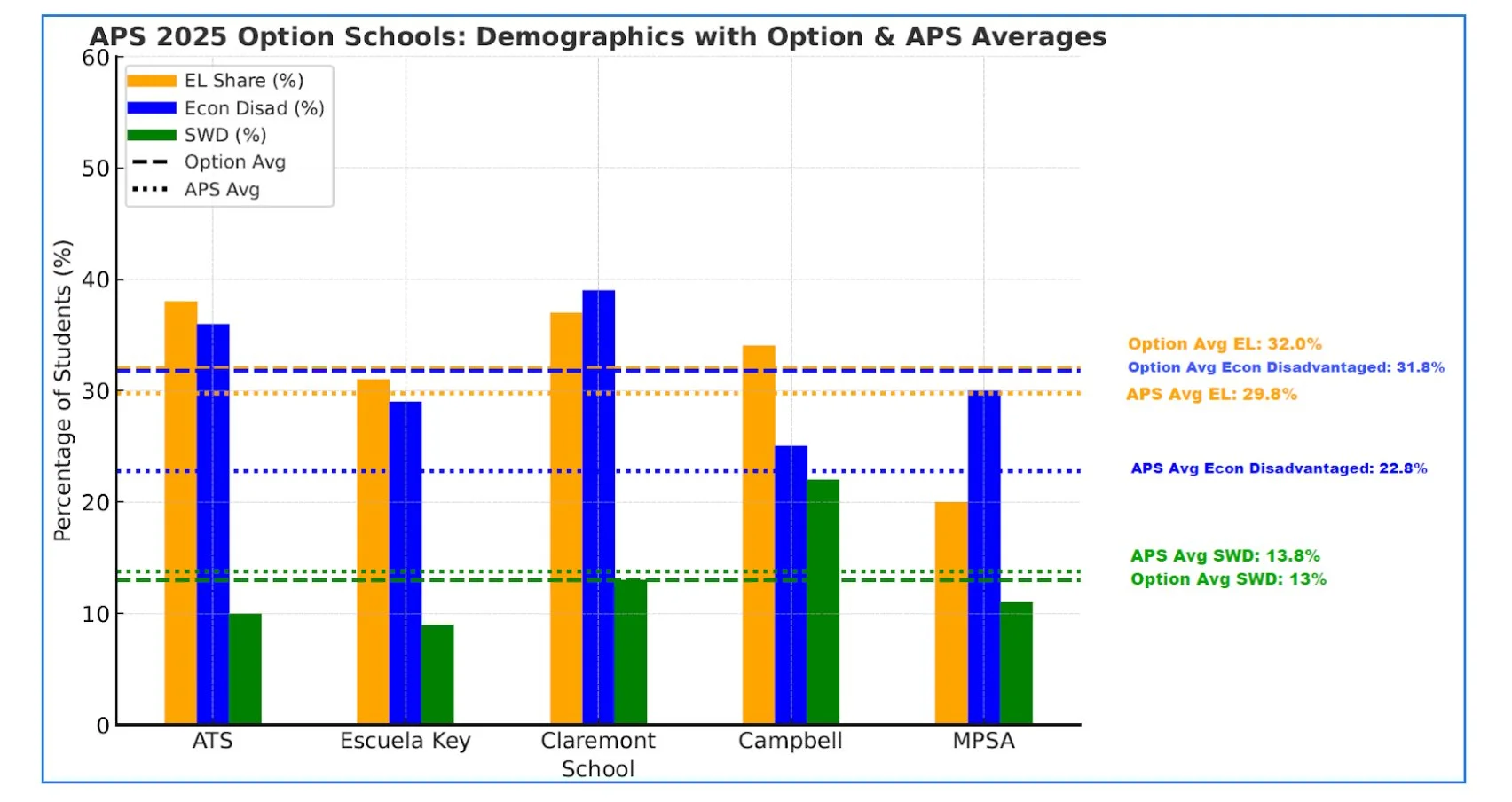
Data from Virginia School Quality Profiles (note, there are known complications to tracking Econ-disadvantaged data post a school being identified as CEP that may affect Econ-disadvantage averages and school-specific numbers)
She opposed pursuing alternatives like moving MPSA to an existing elementary school (e.g., via boundary changes or busing), arguing it would cause greater disruption and fail to prioritize vulnerable students' needs. She cautioned against boundary adjustments that could destabilize neighborhoods and encouraged creative uses for excess elementary capacity (e.g., leasing to daycares during renovations). She also referenced the bond sold to voters had this move listed in it.
APE Note: Here is the exact bond wording:
Question
Shall Arlington County contract a debt and issue its general obligation bonds in the maximum principal amount of $83,990,000 to finance, together with other available funds, the cost of various capital projects for Arlington Public Schools?
Explanation
This proposal will make funds available for the Arlington Public Schools' capital improvement program. The anticipated costs of the projects that may be financed under this proposal are:
Major Infrastructure Projects ($24,600,000)
• Kenmore Synthetic Turf Field ($2,440,000)
• Refresh Legacy Career Center Building to House Montessori Public School of Arlington ($45,470,000)
• Kitchen and Entrance Renovations ($11,480,000)The School Board may reallocate bond funds among other school projects within the School Board’s Capital Improvement Plan, as amended from time to time, to the extent necessary or desirable.