September 15, 2026
In This Edition:
1. Homework and Grading Policy Updates
2. Civic Federation Candidate Forum
3. APS SOL Scores
4. Virginia SOL Scores
5. Lightspeed Reporting
6. Happening SoonOur 2025 Annual Survey results are coming soon!
APS to Provide Daily Numeracy & Literacy Practice and Greater Consistency in Grading
APS revised both its Homework and Secondary Grading Policy Implementation Procedures (PIPs) this summer, adding daily elementary literacy and numeracy practice and tighter limits around late work and retakes. Both revisions hold promise for advancing APS student learning.
What Changed?
Homework: APS is now calling for elementary students to be provided with daily numeracy and literacy practice to be completed outside of school. Regular practice is critical to i) building automaticity with math facts and fluency with procedures and ii) developing and solidifying reading skills.
Secondary Grading: APS is providing substantially clearer guardrails on deadlines for late work and test retakes:
1) Late work will generally be due within seven calendar days or by the end of the unit, whichever comes first. Work submitted later may receive no credit or a zero, and the existing up-to-10% late penalty remains.
2) Test retakes and revisions should be completed within two weeks of the original summative assessment.
Students are not eligible for a summative retake or revision if they:
have not completed the related formative work;
have more than two late assignments in the unit;
have more than three unexcused absences in the course that quarter; or
received the assessment score because of a confirmed academic-integrity violation, including plagiarism or unauthorized AI use.
Why It Matters
Students need clear, time-limited windows to submit work to improve their executive functioning skills. Teachers also need greater deadline structure to avoid being deluged with late work at the end of the quarter.
APS student SOL performance remains below pre-Covid levels and recent yearly gains have been anemic. To its credit, APS has recognized the need to refocus its curriculum around Science of Learning principles as a way to boost student achievement.
Science of Learning is informed by cognitive science and stresses the need for repeated practice to build foundational skills necessary for complex problem-solving. This guidance is consistent with best practices for math instruction for struggling students as well.
School-provided practice also has an important equity benefit. Families with greater resources can independently purchase tutoring, enrichment or additional academic practice. A school system should ensure that students who do not have access to those supports still receive regular opportunities to practice essential skills. Now disadvantaged students will have access to these practice opportunities as well. To be successful, all students will need to receive feedback on their practice.
Bottom Line
APE has advocated for years for more purposeful academic practice. We applaud these PIP revisions and urge APS to go farther. As APS updates the underlying Homework and Grading policies, we will continue advocating for:
Meaningful feedback on elementary homework, even if it is not formally graded.
Firm, reasonable deadlines and guardrails around retakes.
Required relearning or remediation before reassessment.
Grading systems that give families a clear and reliable picture of student performance.
Public evaluation of whether APS grading changes are actually improving learning outcomes.
That last point remains especially important with Standards-Based Grading. A grading system is only useful if families can understand whether a student is on track and identify problems early—not after an SOL or other high-stakes assessment reveals them.
What You Can Do
APS will be updating its accompanying Homework and Secondary Grading Policies this year as well. We encourage you to share your views with APS on these topics by emailing the Director of Policy and Legislative Affairs, Steven Marku. In particular, we urge APS to explicitly highlight the role that homework and consistent grading practices play in the development of executive functioning skills, as well as the importance of timely feedback and a more clear grading system for elementary students.
Read more here on Arlnow.
Arlington School Board Candidates Face Off at Civic Federation Forum
Arlington’s two School Board candidates offered voters their visions for APS at the Arlington County Civic Federation’s annual candidate forum this week.
The big picture: James “Vell” Rives and Bethany Zecher Sutton fielded questions on academics, school finances and facilities, discipline, student safety, bullying, School Resource Officers and inclusion.
Their views: Rives made the case for a change in direction, emphasizing fiscal restraint, stronger disciplinary consequences, reinstating SROs and greater ideological diversity on the School Board. Sutton emphasized continuity and experience, highlighting APS’ recent academic changes, investments in teacher and student supports, flexible facilities planning and the district’s existing safety structure.
Where they agreed: Both candidates emphasized the importance of supporting teachers, maintaining safe schools, addressing aging facilities and taking bullying and hate speech seriously.
Catch up: If you missed the forum, you can watch the full candidate forum on Facebook and hear directly from both candidates before Election Day. Read more coverage from ArlNow here.
Arlington Parents for Education is pleased to be a member organization of the Civic Federation, which brings together civic associations and community organizations from across Arlington to engage on issues affecting the county.
APS SOL Scores Post Modest Gains as Learning Losses Persist
The Virginia Department of Education released 2025-26 SOL scores in August. APS posted small gains in reading and math; math SOL pass rates rose 1.4 percentage points from the prior year, while reading edged up 0.4 percentage points. However, both remain well below their pre-Covid levels. (The true magnitude of the 2019-26 drop in reading is cloaked because cut scores were lowered in 2021, which inflated reading pass rates thereafter. Read more here.)
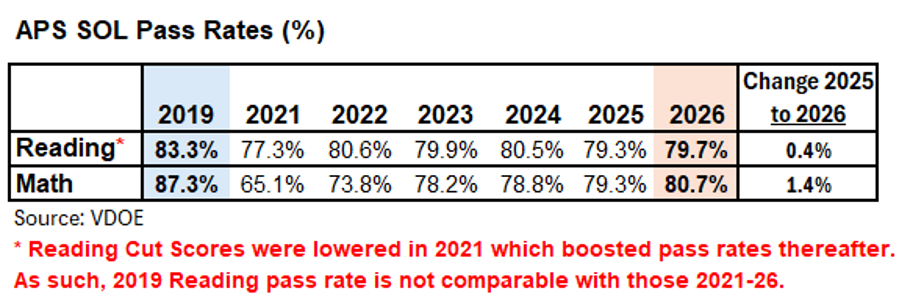
APS scored above the state in most categories in 2025-26, however, this is usually the case since northern VA incomes are higher than those in the rest of Virginia.
Pass rates for vulnerable APS demographic groups were lower than overall, with gaps especially large for English Learners (EL). While EL posted gains in 2026, the gap between EL and non-EL students remains wider than pre-Covid.
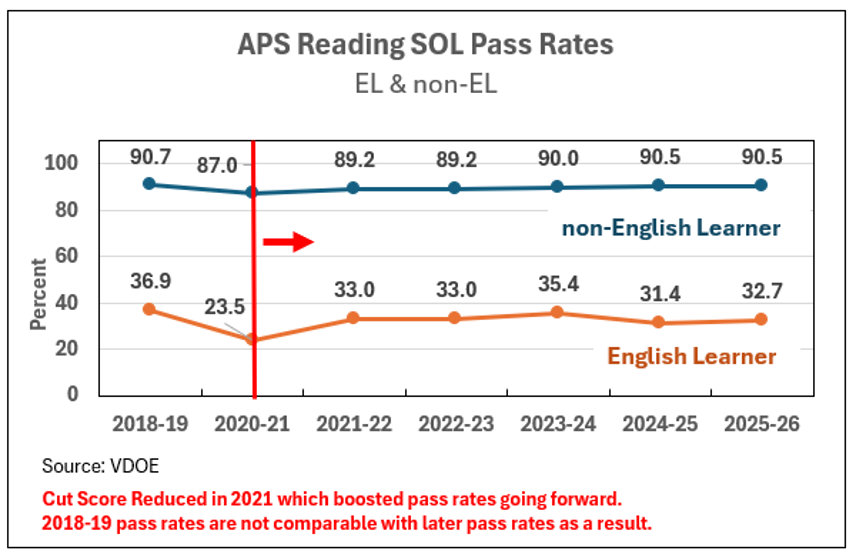
With significant learning losses still remaining, APS should continue examining whether some post-2020 policy choices, including more permissive late-work and retake practices, increased device use, and a reduced emphasis on executive functioning skills may be making it harder for students to reach their full potential. We applaud APS’ recent revisions to its Homework and Grading Policy Implementation Procedures and its efforts to reduce unnecessary device usage. These are important steps in the right direction. We urge APS to build on that progress by continuing to strengthen policies and practices that promote consistent effort, accountability, focus, and strong academic habits so that every student has the opportunity not simply to recover, but to thrive academically at levels beyond those seen before the pandemic.
Virginia Students Edge Up on SOLs as Lowest-in-the-Nation Cut Scores End
The big picture: Statewide 2025–26 SOL pass rates ticked up 0.4 percentage points in both reading and math, extending a five-year rebound even as more middle schoolers moved into accelerated high school math. History and social science SOL results were up 3.2 percentage points from last year, while Science was down 0.2 percentage points. Virginia students’ performance still has not returned to its pre-Covid performance levels.
Successful math acceleration: Although Grade 7 and 8 grade-level math pass rates slipped slightly, that dip was caused by good news: a larger share of seventh- and eighth-graders successfully sat for high school end-of-course math tests instead of the grade 7 or 8 SOL. Ninety-five percent of those accelerated middle schoolers passed—up nearly a point from the prior year. That pattern matches a multiyear push to get more students into Algebra I and beyond earlier.
What’s changing: These reading and math results still use the old 400 “pass/proficient” bar—cut scores long noted as the lowest in the nation and out of line with the nation’s report card, the National Assessment of Educational Progress (NAEP). Starting this school year, Virginia phases in higher cuts over four years to align with NAEP cut scores, with a temporary, gradually increasing “approaching” cut-score level that still counts as passing for accountability until full implementation in 2029-30.
What’s next: At the August Board of Education meeting, the Spanberger administration reiterated support for that four-year transition plan. Officials also said they will develop a method for year-over-year SOL comparisons as the passing bar rises each year—so parents and divisions can still track real progress when “proficient” is no longer the same number.
Bottom line: Modest gains and more kids taking harder math are real improvements, although performance remains below pre-Covid levels. Next year’s scores will look different on purpose. But how the state reports apples-to-apples improvement will matter as much as the raw pass rates.
APS Lightspeed Content Filter Reporting Tool
A small but important win! We’ve been advocating for an easier way for families to report non-academic websites to APS, while continuing to push for an allow-list model so we can stop playing whack-a-mole with distracting and non-instructional sites. APS has now rolled out a much easier way to report them! Email the URL to websitereview@apsva.us.
Image from APS "What's Up Wednesday! September 2, 2026" email
Happening Soon
Tuesday, September 15, 6:30–8:00 PM – AI Community Conversation: AI Roundtable. Wakefield High School. APS is inviting families and staff to share their experiences, questions, benefits, concerns and priorities related to AI in APS. Feedback from the small-group conversations will help inform APS' next phase of AI guidance, communications, professional learning and implementation. RSVP here.
Wednesday, September 16 – H-B Woodlawn Back-to-School Night. APS Calendar.
Thursday, September 17 – Elementary Back-to-School Night. APS Calendar.
Monday, September 21, All Day – No School: Yom Kippur. APS Calendar.
Wednesday, September 23 – Grace Hopper Center Back-to-School Night. APS Calendar.
Thursday, September 24 – Middle School Back-to-School Night. APS Calendar.
Thursday, September 24, 7:00 PM – School Board Meeting. Syphax. Academic Data Update and action on the FY 2026–27 Internal Audit Work Plan are scheduled. Sign up to speak beginning Friday, September 18 at 4:00 PM | Watch live | Agenda/Materials.
Thursday, September 24, 6:00 PM - 8:00 PM - The Balance Project's Perspectives Panel. Washington Golf. More details here.
Tuesday, September 29, 9:00 AM–4:15 PM – School Board Work Sessions. Syphax. Topics include planning factors, FY 2028 budget direction, facilities/maintenance and the school-year calendar. Watch Work Sessions.
Don’t forget! You can subscribe to APS School Calendars! Click the "Subscribe to Calendar" in the bottom right section of the page.
NOTE: Make sure you are tracking the recent calendar change for Elementary School parent-teacher conferences. Now, Elementary will have an early release day on the 8th of October and a no-school day on October 9th for parent-teacher conferences. Read more here.