October 16, 2025 Newsletter
In This Edition:
1. Dr. Durán Opposes Raising State Academic Standards
2. APE Supports Raising SOL Cut Scores
3. Get to Know The School Board Candidates
4. Parent Tips: Setting Up Lightspeed
5. Policies Open for Your Feedback!
6. School Board Meeting Recap
7. What's Happening Soon
Dr. Durán Wants APS to Oppose
Virginia Raising Academic Standards
At the last School Board meeting, Dr. Durán spoke against the Virginia Board of Education’s recent proposal to increase proficiency thresholds for standardized testing (aka SOL cut scores for passing). He requested that the School Board add to its formal requests to Arlington’s state legislators that they take legislative action against the new proposed cut scores (typically NOT the purview of a state legislature).
Background on Cut Scores
When Dr. Durán served on the Virginia Board of Education (2018-2022), he helped set the current Math and Reading cut scores to the lowest levels in the nation. That decision drew bipartisan criticism, including from multiple Washington Posteditorials, and became a major issue in Glenn Youngkin’s winning 2021 campaign.
In 2020, Dr. Durán led the State Board in rejecting the State Superintendent’s proposal for higher Reading standards, instead adopting lower proficiency thresholds that were recommended by a committee made up only of K-12 educators. At the time, he claimed that the State Board historically deferred to that committee and that setting academic standards is an “educator-driven process.” But many people believed that the State Board—whose members are approved by the Virginia legislature—automatically deferring to this committee avoided proper accountability, and its educator-only structure raised conflict-of-interest concerns.
What’s Different Now
This time, the State Board used a broader, more balanced standards-setting committee of education stakeholders, including leaders from the military, higher education, K-12 education, and business, as well as parents. At the last School Board meeting, Dr. Durán referenced the old educator-only committee but did not note that today’s proposed cut scores came from this new, more diverse committee.
Fact Check: Discussion at the School Board meeting was misleading in numerous other ways:
Omission of the context that Virginia’s current proficiency cut scores are the nation’s lowest (now tied with one other state);
Omission of the fact that the level to which Virginia is proposing to raise cut scores is consistent with many other states like Colorado, Maryland and Massachusetts;
Omission of the fact that the proposed cut scores include an intermediate level between the bottom category and proficiency (i.e., in addition to the temporary “Approaching” level), like in other states—the intermediate level’s cut scores will be close to the “Pass” level of the current cut scores;
The complaint that the State Board is raising the cut scores “in the middle of the year” (with a 4- or 5-year phase-in) is inconsistent with when Dr. Durán was on the State Board and he himself voted to lower cut scores in the middle of the school year (notably, the 2019 Math cut scores were lowered two months before tests started being administered);
The statements that the State Board is acting “as of late” on a “feeling” to align the cut scores with NAEP (“the nation’s report card”), and agreeing that “no arguments have been made” for why the cut scores should be raised, were all patently false; the possibility of aligning the cut scores with NAEP was discussed at Dr. Durán’s final State Board meeting in June 2022 and, for the past three years, the State Board has been publicly working with leading national experts on why, how, and to what level, these cut scores should be raised; and
The implication that raising the cut scores is a nefarious way to undermine public education while omitting the fact that raising Virginia’s cut scores is supported by the head of the leading educational civil rights organization, The Education Trust, among many others, who have called for Virginia to close its massive “honesty gap” (defined as the difference between state-reported proficiency rates and those set by NAEP).
The Big Picture: We strongly agree on this issue with Arne Duncan, former U.S. Secretary of Education under President Barack Obama (and former APS parent for 6 years). Here he was last year commenting on Virginia’s low cut scores along with the opaque accreditation system in place at the time:
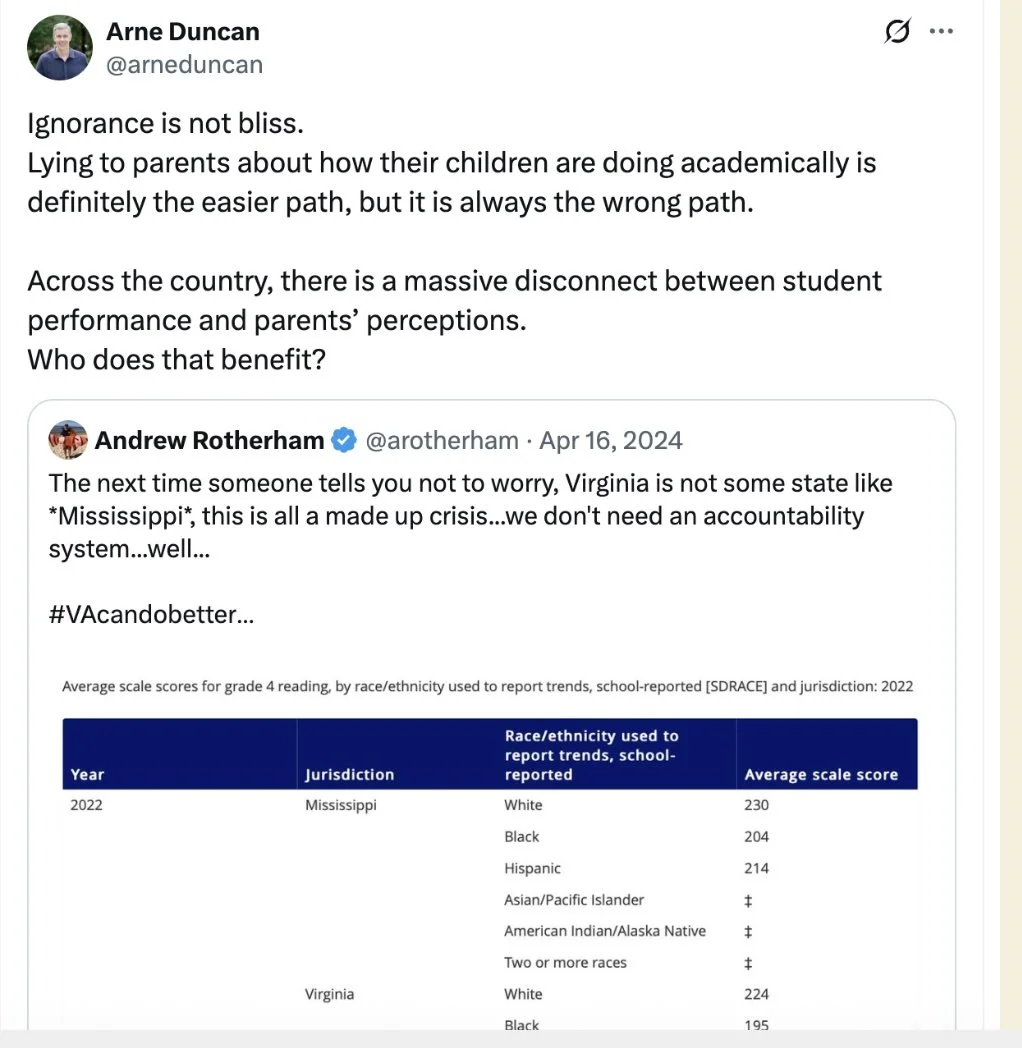
What’s Next: The School Board is considering whether to include a request to our state legislators for extraordinarylegislative action opposing the new cut scores, which would be voted on at its next meeting.
We highly oppose the School Board doing so. Virginia parents deserve specific, actionable information about their children’s academic progress just like parents in other states receive. Raising the bar is true educational equity—you cannot close achievement gaps by lowering expectations.
Please email the School Board and ask them not to support watering down state standards again.
APE Supports Raising Virginia's Low SOL Cut Scores
APE recently submitted a letter to Virginia Secretary of Education Aimee Guidera, State Superintendent Emily Anne Gullickson and the Board of Education voicing strong support for the new proposed Math and Reading cut scores (proficiency thresholds for standardized testing) as well as articulating preferences regarding certain implementation issues. Read the full letter here.
Why It Matters: Virginia’s current proficiency cut scores are the nation’s lowest (now tied with one other state). Prominent national education advocates have been calling for Virginia’s cut scores to be raised for the past several years, including:
Arne Duncan, former U.S. Secretary of Education under President Barack Obama (and former APS parent for 6 years);
Denise Forte, head of the leading education civil rights group, the Education Trust;
Jim Cowen, head of the nonprofit Collaborative for Student Success;
Thomas Kane, professor at the Harvard Graduate School of Education; and
Mark Schneider, former head of the Institution of Education Sciences at the US Department of Education.
Virginia adopted new, more rigorous Math and Reading standards in 2023 and 2024, respectively. As part of a 3-year process, the Virginia Board of Education voted last month to set a new intermediate threshold and significantly increase the proficiency threshold (aka cut scores) on Math and Reading SOL exams to levels consistent with “the nation’s report card,” the National Assessment of Educational Progress (NAEP).
These new cut scores will raise academic standards while also providing more nuanced and actionable information to parents, teachers and the community about children’s academic progress.
The Bottom Line: Virginia has a massive “honesty gap” (defined as the difference between state-reported proficiency rates and those set by NAEP). For instance, on NAEP’s 4th grade math test in 2024, Maryland had a 38% proficiency rate while Virginia had a 40% proficiency rate. In contrast, on their respective state math assessments for the 2024-25 school year, 4th graders in Maryland had a 35% proficiency rate while Virginia 4th graders had a 73% proficiency rate.
The Backstory: Per the U.S. Department of Education, Virginia has the lowest proficiency cut scores for Math and Reading in the nation (tied with one other state). The Math and Reading cut scores were lowered by the Board of Education in 2019 and 2020, respectively. The Virginia Board of Education will likely soon approve a plan to raise them.
To give schools time to adjust, the State Board will approve either a 4- or 5-year phase-in process for the new proficiency cut scores at its next meeting. The State Board is also adding a temporary category titled “Approaching” between the new intermediate level and the higher proficiency level to help facilitate the phase-in.
What’s Next: The Board of Education will meet later this month and again in November to decide on outstanding issues regarding the implementation of these new cut scores. APE’s letter recommended the following on these issues:
Preference for a 4-year phase-in vs. the alternative option of 5 years.
Raise the bar for verified credit for graduation to at least pre-2019 levels.
Adopt NAEP nomenclature (Below Basic / Basic / Proficient / Advanced) to more clearly reflect changes to the “proficiency” level and the new intermediate level vs. the current Fail / Pass / Advanced categories.
Incentivize placing more students into Algebra by 8th grade by modifying the middle school advanced coursework accountability factor for the new proficiency level.
School Board Candidates Lay Out Their Visions
Why It Matters
Arlington Public Schools is facing a wide range of key decisions, from instruction and student support to calendar and grading policies. This forum, moderated by Scott Gelman from WTOP, offers voters a clear look at how both candidates would approach a variety of topics, including homework policies, school safety, community engagement, fiscal responsibility and more.
Dive Deeper
To hear the candidates in their own words and experience the full conversation, watch the complete School Board Candidate Forum recording.
What’s Next?
Early Voting is open for the 45 days leading up to all elections. All voters can vote at any Early Voting location. Early Voting hours and locations can be found here.
On Election Day, all Arlington polling places are open from 6 a.m. to 7 p.m. You must vote at your assigned polling place on Election Day. Where Do I Vote?
Read more in ArlNow's Coverage.
Parent’s Helping Parents
Setting Up Lightspeed
We continue to advocate for APS to improve the Lightspeed report, which shares screen time information with parents on a weekly basis. We have asked APS to remove purely administrative websites and enable the time-spent feature so parents can more accurately see what their children are doing online and for how long. In the meantime, we strongly encourage parents to sign up and take advantage of the information that is already available.
Parents can opt in through ParentVue to receive the Weekly Online Student Activity Report and to set up access to the Lightspeed Parent Portal. When one parent opts in, both parents/guardians are automatically enrolled.
Directions for opting in through ParentVue are available here.
If you need additional help, please contact the Family Helpline at 703-228-8000.
Within one week of opting in, you should start receiving a weekly email from APS.
APS Needs Your Feedback
Check the APS website for policies that are open for public feedback: APS
October 9th School Board Meeting Recap
Highlights from the October 9th School Board Meeting include:
1.FY 2027 Budget DirectionApproved
The Board unanimously adopted the FY 2027 budget direction (5–0), which sets the framework and priorities the Superintendent must follow when developing the proposed budget to be presented in February.
2.2026 Draft Legislative PackagePriorities Discussed
The Board reviewed and advanced its legislative priorities, focusing on:
Opposing “unfunded mandates.”
Seeking increased state funding for chronic absenteeism, social workers, and equitable resources.
Supporting weighing growth as heavily as mastery for state’s accountability and accreditation system
Supporting protections for gender expression, gun safety measures, and maintaining local control over library materials
3. Expansion of Community Partnerships & Launch of “Readers Rise” Pilot
APS is formalizing how it tracks and evaluates school partnerships, including a new rubric and central coordination. See presentationhere. As part of this work, APS will launch the Readers Rise literacy volunteer pilot in three schools starting October 21, with over 190 volunteers expressing interest in just two weeks. (APE Side Note - YAY!)
Readthe full recap here.
Happening Soon
Thursday, October 23, 7:00 PM – School Board Meeting. Syphax (Board Room, 2110 Washington Blvd.). Sign up to speak. Watch live.
Friday, October 24, 8:00 AM – Audit Committee Meeting. Syphax (School Board Conference Room, Suite 260)
Tuesday, October 28, 7:00–9:00 PM – ASEAC Meeting (Virtual). Details.
Wednesday, October 29, 8:30 AM – School Board Policy Subcommittee Meeting. Syphax (School Board Conference Room, Suite 260)
Wednesday, November 5, 7:00–8:30 PM – ACTL Meeting. Syphax Rooms 452/454/456. Details.
Thursday, November 13, 7:00 PM – School Board Meeting. Syphax (Board Room, 2110 Washington Blvd.). Sign up to speak. Watch live.
Tuesday, November 18 – School Board Work Sessions. Syphax (Board Room, 2110 Washington Blvd.). Watch live.
9:00–10:30 AM: Work Session on the Advisory Committee Working Group
10:45 AM–12:15 PM: Work Session on Non-Traditional Secondary Program
1:00–2:30 PM: Work Session on the Grace Hopper Center Site Programming
2:45–4:00 PM: Work Session on High School Schedules
4:30-5:30 PM: Closed Meeting