June 19, 2025 Newsletter
In This Edition:
1. APE Advocacy Win: APS Volunteer Reading Program Piloting in Fall 2025
2. Intensified 8th Grade Social Studies Confirmed for SY26-27
3. APS Expands Pouches to Four APS High Schools
4. APE Advocacy Win: SOL Results Released Earlier
5. What We're Reading & Listening to This Week
6. School Board Meeting Recap
APS Volunteer Reading Program
Set to Pilot in the Fall
What It Is: Volunteer reading programs show great promise in helping increase literacy levels among elementary students. Data from some programs show test scores among participants increase by 66%. APE has been asking APS to consider implementing a permanent volunteer reading program (like the Read With Me program in CA) across all of APS. Now, APS has indicated that the ELA team is moving forward with a pilot version of such a program in collaboration with the Office of School and Community Relations (SCR). Building on existing volunteer reading programs at Abingdon (Reading Buddies) and Innovation (Everybody Wins DC – Power Readers), APS plans to add 2-3 additional schools this fall. School selection will be guided by data related to reading performance and chronic absenteeism.
Why It Matters: VA reading scores continue to lag behind pre-pandemic levels; this challenge is especially acute in APS among English language learners and socioeconomically disadvantaged learners. APS is also paring down summer school availability for struggling APS readers. An evidence-based volunteer reading program like Read With Me could help dramatically.
What’s Next: To help schools express interest, APS plans to distribute an “interest inventory” survey to principals during the Administrative Conference in August. This opportunity will also be formally shared with school-based leaders at that time, along with outreach materials they can use to help recruit volunteers within their communities. The program is planned to launch at selected schools in October and run through December. During that time, APS will monitor implementation to identify what’s working and what may need adjustment, with the goal of expanding the initiative during the second half of the school year.
What You Can Do: Volunteer and/or spread the word! As soon as recruitment opens, we will let you know!
Make sure you are signed up to volunteer!
Read more from ARLnow on APS expanding partnerships with service groups.
Intensified 8th Grade Social Studies Course Confirmed
We have confirmed with APS that, as reported in ArlNow in January, APS will offer an intensified 8th grade Social Studies course for the 2026-27 school year. APS' last alleged hurdle to offering this class was removed in May: the Virginia Department of Education (VDOE) issued its instructional guides for the new Virginia social studies standards taking effect next fall.
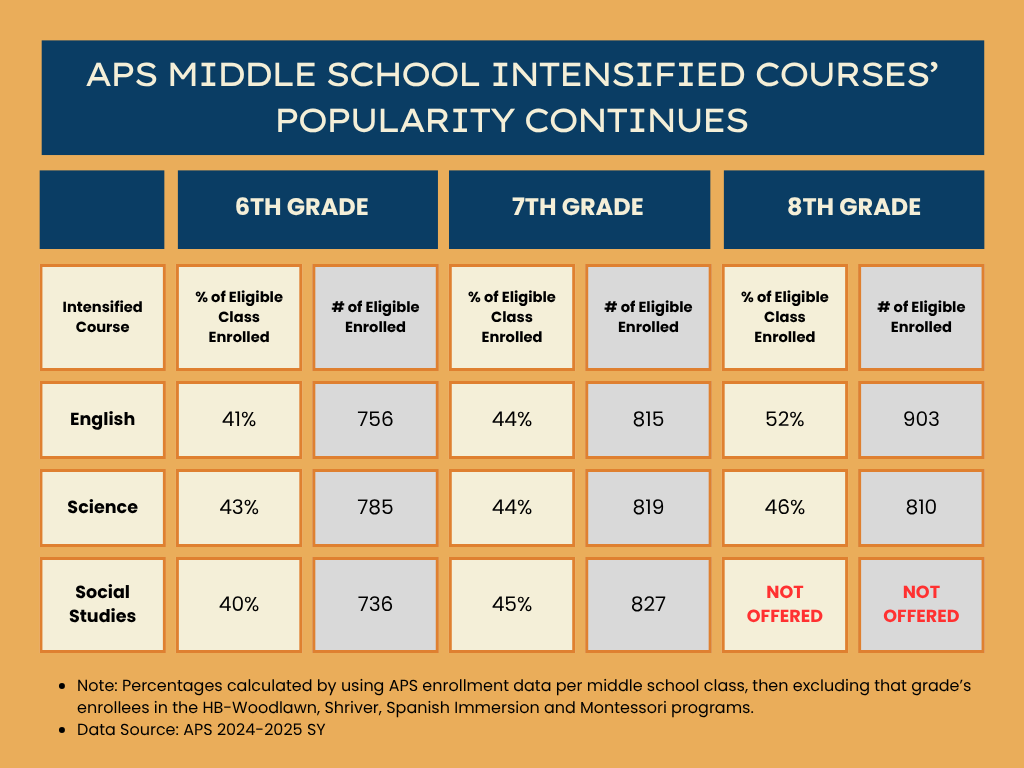
The Backstory: APS began re-offering intensified middle school English, Science and Social Studies courses in the 2023-24 school year, which have been an equity success and very popular with students and teachers. Nonetheless, as we detailed two years ago, APS did not offer an intensified 8th grade Social Studies course in the 2023-24 school year and provided numerous conflicting reasons for why it would neither be offered in the 2024-25 school year. For instance, APS claimed that, because this course was a high school credit course, an intensified course was not needed, despite the fact that APS offers intensified versions of high school credit math courses in middle school.
At the December 2024 School Board meeting, Board member Miranda Turner asked Chief Academic Officer Dr. Gerald Mann about the absence of this class from the proposed Program of Studies for the 2025-26 school year. Dr. Mann stated that the lack of “standards” [sic] (the state adopted the Social Studies standards in April 2023 and the instructional guides were still outstanding) from the state for this course prevented APS from offering an intensified version. It is important to note that the Social Studies standards (which determine the minimum content of courses) were adopted by the state Board of Education over two years ago. The state’s instructional guides simply offer advice for “how” to teach such content, which is important for smaller school districts without large academic departments. Further, APS offered intensified middle school math classes in 2024-25 under new math standards despite having less than a year to implement them and having no instructional guides from the VDOE until June 2024.
Our Take: Although we are disappointed it is not being offered in the 25-26 school year, we are excited that APS will finally offer this course for the 2026-27 school year. Based on current enrollment patterns, we expect that more than eight hundred 8th graders per year will enroll in the intensified Social Studies course once it is offered. APS should start work designing the new course this summer to be prepared to offer it in the 2026-27 school year.
Why It Matters: Dr. Durán was instrumental in getting APS to offer intensified middle school courses, stating that equity requires APS meeting the instructional needs of every single child, including those children who need more challenge. The direction from the School Board and Dr. Durán to APS staff was clear. And APS students and parents are “voting with their feet” and—when intensified classes are offered—signing up to take them in significant numbers, as shown by data provided by APS.
We are thankful that APS will offer this course for the 2026-27 school year.
APS Expands Pouch Program as Virginia Makes Away For The Day the Law of the Land
On May 30th, Virginia Governor Glenn Youngkin signed into law a statewide “bell-to-bell” ban on cellphone use in K–12 public schools, after Virginia's Senate voted unanimously and its House of Delegates voted 98-2 to confirm Youngkin's amendment to ban cell phones and personal smart devices throughout the entire school day. Virginia school divisions have the summer to draft compliance plans, purchase phone storage equipment if necessary, and communicate the new rules to parents and students. The law takes effect July 1, 2025, and prohibits students from using cellphones and smartwatches during instructional time unless explicitly allowed by a teacher for academic purposes or medical necessity (these exceptions can be included in IEP and 504 accommodations). Virginia, the District of Columbia and nine other states have enacted "away for the day" personal device policies, where cell phones cannot be used throughout the entire school day, while seven states restrict cell phones during instructional time only.
Why It Matters: Days later, the Superintendent's June 4th Weekly message included important findings regarding APS' new policy this school year which banned the use of personal devices during the school day, except for a designated time and place during the lunch hour. Wakefield High School piloted the use of Yondr pouches, while the rest of the high schools required students store devices in locations like backpacks or lockers. According to the 2025 Your Voice Matters survey, which asked about the impacts of the division's new personal device policy survey of staff, students and families, the policy "positively impacted instructional time, reduced distractions, and contributed to positive school climates for all." However, major differences in experience existed between Wakefield, with its pouch program, and the other high schools, which required students to store devices in various places. At non-pouch schools, only 55% of staff felt the policy "helped manage the use of cell phones," while 88% felt that way at Wakefield.
What's Next: Dr. Durán therefore announced that in the 2025-26 school year, pouches will be rolled out for the Career Center, H-B Woodlawn, Washington-Liberty, and Yorktown high schools. These pouches will no doubt help facilitate compliance with the new state law as well, which requires APS to be more restrictive than it was during the 2024-25 school year. This time last year, APS engaged with the community regarding a cell phone policy, and to help reach consensus on the issue APS ultimately carved out a limited exception for cell phone use during the school day whereby students could check their messages during the lunch hour. However, this exception will no longer be allowed under the new state law. The expansion of the pouch program will help schools which face logistical challenges--like no lockers--to comply with the new state law by better restricting phone access throughout non-instructional times as well.
Our Take: We are very proud that APS has been a leader on the issue of cell phones in school. Its successful pilot program of the phone pouch, and its broader Away For The Day policy, provided valuable information to not only Arlington leaders but leaders throughout the state. The nearly unanimous legislative support for the governor's bell-to-bell law reflects that leaders from across the commonwealth now understand the critical importance of creating device-free learning environments. Arlington served as a critical proving ground and no doubt encouraged other districts to seek personal device restrictions in their schools as well.
Read our advocacy on this issue here and various letters here.
Thank You, APS: Parents Deserve Timely SOL Results to Support Student Success
Arlington Parents for Education wrote to the School Board to respectfully urge that APS release student SOL scores more promptly. We are so appreciative that APS decided to release the scores by June 13th for most students!
While we appreciate the progress made in recent years, in which APS has moved score releases to late June rather than late July or August, many APS families still need this critical academic information before the end of the school year. These scores are available much earlier to APS, and they should therefore be shared with parents much earlier.
Timely access to SOL results allows families to understand where their children are thriving and where they may need support before the next school year begins. Sharing this information as soon as possible is also a matter of transparency and respect; students work hard on these assessments and deserve to know how they performed.
See the letter we sent, which outlines our position on SOL data and includes comparisons to the practices of neighboring districts such as Fairfax County.
What We’re Reading and Listening To
Mental-health lessons in schools sound like a great idea. The trouble is, they don’t work (The Guardian)
"All-class therapy sessions don’t help, and may even make matters worse. The evidence shows we need different solutions. On the face of it, mental-health lessons in schools seemed like an excellent idea. Young people’s mental health is worse now than it was in the past, and one-to-one treatment is hard to access. If you teach young people about mental health at school – which often includes teaching techniques based on therapies such as cognitive behavioural therapy (CBT) or mindfulness – it’s more accessible…At least, that was the idea. The reality is more sobering… The best-designed studies show that interventions don’t work at all: no improvement in mental health symptoms, either immediately after the course of lessons or later down the line."
Parent says no, stop the screen rot in schools (The London Times)
"Bravo to the education committee for finally saying what we all know to be true: for young children, screens are like — and I’m paraphrasing here, but not by much — crack, in terms of rotting their brains and being ludicrously addictive. In its new report, “Screen time: impacts on education and wellbeing”, the committee concluded, “The overwhelming weight of evidence submitted to us suggests that the harms of screen time and social media use significantly outweigh the benefits for young children.” In other words, it’s not social media that’s the problem. It’s screens themselves."
Facing special ed teacher shortage, Va. Education board votes to expand educator pipeline(Virginia Mercury)
"The number of Virginia preschoolers with disabilities has increased by 24% over the past two years, prompting the Virginia Board of Education’s decision Thursday to have the state find new ways to get more special education teachers into classrooms. The board’s unanimous 7-0 vote directs the Virginia Department of Education (VDOE) to open the state’s compliance pathways in its state administrative code governing special education by removing the requirement for graduate-level coursework earned towards an Early Childhood Special Education (ECSPED) endorsement."
Some Chicago high schools are rethinking lenient grading amid surging absenteeism(Chalkbeat Chicago)
"Schools such as Richards High School tried more flexible grading during the pandemic. After students were passing with little effort and not coming to class, schools are reversing course. Teachers at Richards Career Academy High School on Chicago’s Southwest Side raised a question last spring that took principal Ellen Kennedy aback: Should the school stop giving students so much leeway on grades and go back to stricter standards? The school — which serves mainly low-income Latino and Black students — had piloted a new grading approach in 2019, then embraced it when the COVID-19 pandemic disrupted students’ lives and learning. Students could redo assignments repeatedly and turn in work late. Even if they didn’t complete the assignment, the lowest score they could get was 50 rather than zero — a concept known as no-zero grading."
In Dozens of Districts, Teachers Can’t Afford to Live Near Their Schools (The74)
"In a recent analysis, Katherine Bowser of the National Council on Teacher Quality finds that teachers are increasingly being priced out of housing in their communities. She notes that, between 2019 and 2024, the percentage growth in home prices and the cost of renting a one-bedroom apartment have significantly outpaced increases in both inflation and teacher salaries.
In short, teachers face, “a widening gap between income and housing affordability,” according to NCTQ President Heather Peske."
See something that strikes a chord? Something you disagree with? Join the discussion on our Facebook page!
June 12th School Board Meeting Recap
Highlights from the June 12th School Board Meeting include:
Graduation Outcomes: APS reported a 97.8% graduation rate, with gains in early reading and college-level coursework. Priorities for next year include improving instruction and special education staffing.
• Public Concerns: W-L teachers voiced dissatisfaction with leadership decisions and staff treatment. Other comments addressed Title I status loss, solar contract concerns, non-binary student policies, and transportation equity.
• Budget Surplus: APS ended Q3 with $15.5M more than projected, driven by higher state revenue and lower spending. $3.5M will carry over to FY26; the rest remains unallocated.
• Facility & Policy Updates: APS proposed a $1.2M change order for Grace Hopper site issues, to be covered by contingency funds. Policy revisions and collective bargaining updates were reviewed.
Read the full recap!