February 20, 2025
In This Edition:
1. Budget Consultant Recommends Cost-Saving Measures
2. Standards-Based Grading Poll
3. Lowering Prerequisites for HS Math
4. Parent's Corner: Let Us Opt Out of iPads
5. School Board Meeting Recap
6. Happening Soon
APS Budget Consultant Recommends Cost-Saving Measures
Arlington Public Schools is exploring significant cost-saving measures to address “structural deficit” concerns for its upcoming budget. In a recent report, consulting firm Baker Tilly recommends a series of significant changes designed to save millions. The report covers many areas of APS, including a review of current processes, staffing levels, enrollment, and takes deep dives into class sizes and capacity.
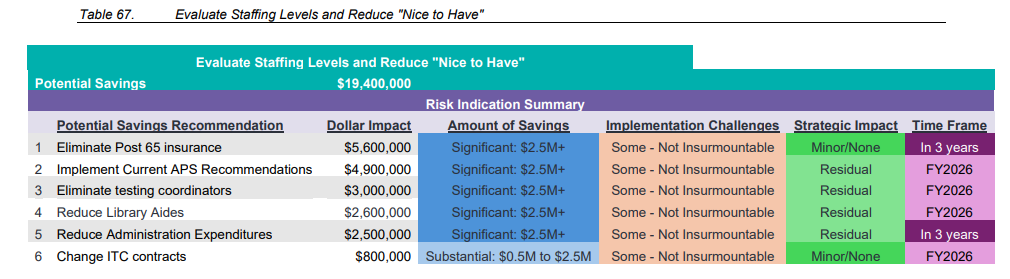
Baker Tilly Final Report, page 92.
Key proposals include:
Eliminating post-65 retiree insurance benefits, which would reduce expenses for retirees transitioning to Medicare, aligning with best practices from the Government Finance Officers Association (GFOA). “Peer school divisions offer some insurance past 65 to its retirees, the magnitude of the expense cannot be ignored when considering other reductions that will have much more direct impacts on students.”
$4.9 million reduction in centralized service costs, targeting non-student-facing roles to trim excess administrative spending. This includes cutting positions like testing coordinators and general education/library aides, which are deemed as “nice to have.”
Addressing the challenge of high administrative costs, since APS has the highest administrative costs among peer districts.
Changes in staffing practices, such as reducing the number of assistant principals in elementary schools and reevaluating summer school funding to save on administrative contracts.
Cutting Integrated Technology Coaches’ contracts from 12 months to 10 months, for an estimated savings of $800,000.
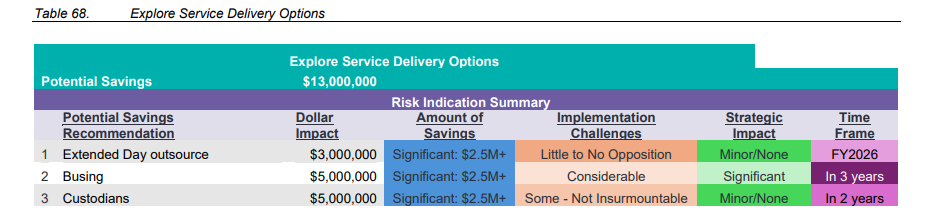
Baker Tilly Final Report, page 94.
Proposed changes to service delivery include:
Outsourcing Extended Day services to a private vendor to offer greater opportunities for families while saving APS an estimated $3 million in combined savings from reduced extended care expenditures and facilities rental fees.
Outsourcing transportation services, a common practice among U.S. school districts, could result in a potential $5 million annual savings, although would also reduce APS' control over transportation operations and impact current staff.
A phased-in approach to piloting the outsourcing of custodial services.
These proposed reductions reflect APS' efforts to manage rising costs while ensuring resources are directed towards direct educational support.
Read the full report.
Read ArlNow's coverage of current budget processes for APS
Report Cards Are Out!
Take Our Standards-Based Grading Poll
APS has adopted Standards-Based Grading (SBG) at all APS elementary schools except for Arlington Traditional school, changing elementary school report cards from "traditional" letter grades to a set of "standards" or learning objectives with performance levels expressed numerically. Each key learning standard can have many learning objectives tied to it.
We want to hear from you about how you feel SBG is going at APS! If you have more than one elementary student, please feel free to fill out multiple times to reflect your experience with each child. We will share the results with APS and ACTL as an organization representative.
Take the survey!
APS Lowering Prerequisite Requirements for High School Math Courses
For SY 2025-26, APS lowered the minimum grade in prior coursework that is needed to qualify for some high school math courses to a “D or better,” and is using the same criterion to allow students to move from regular math sections to intensified sections (HS Program of Studies). The idea behind these changes is to make high school math course selection less rules-based and encourage more dialogue between teacher, student, and families on placement decisions. They also make it easier for a student to move between regular and intensified math courses.
The Backstory: The following chart shows the minimum grade needed to qualify for intensified high school math courses and how it has changed since 2018-19:
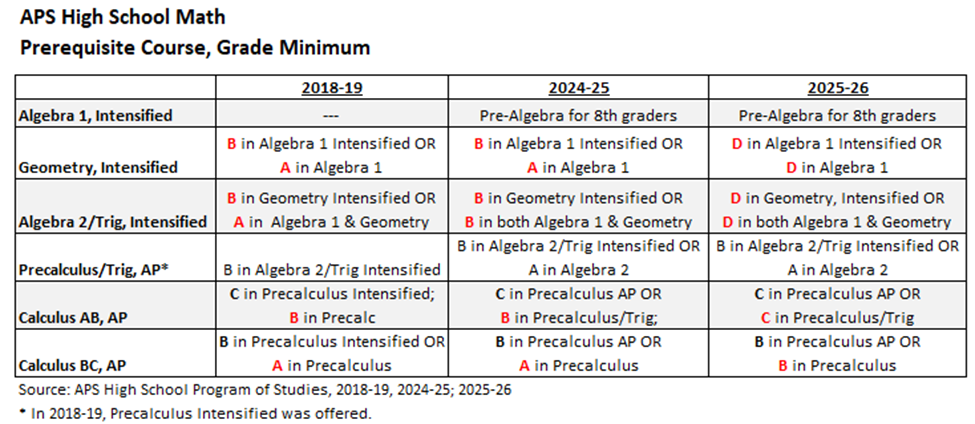
The new changes are consistent with the recommendations of EquitableMath (page 18): “Often, placement into different tracks reflect subjective metrics of innate ability without acknowledging prior opportunities or experiences. … Incorporate a more robust course selection process that allows for multiple perspectives, including student, parent, current and previous teachers, advisors, and others who might also have relevant information”
Why It Matters: While it is important to ensure student access to advanced math, there are several potential concerns with these changes. First, math course selection will be even more opaque and carry less specific grade guidelines, which may create confusion for families and lead them to think that a “D” in a regular math course is sufficient preparation for an intensified math course the following year. Second, if APS makes use of these lower prerequisites, intensified math classes could become more heterogeneous, making it harder for teachers to meet the needs of all students. Third, higher grade minimums in prior math courses have been used to ensure that students have a strong enough foundation to thrive in the next year’s course; it is unclear if lower grade minimums will do the same.
Our Take: In order to ensure students are supported properly, if APS intends to place a student with a 'D' in regular math into an intensified math class the following year, APS should: i) first offer a placement test to ensure the student is prepared for the next year’s course, and ii) require all high school students to take math SOL exams through Algebra 2, providing an objective measure of how well students are faring under the new prerequisites policy.
Parent's Corner:
APS Must Allow Parents to Opt Out of School iPads
(Editor's Note: From time to time we will offer an unedited perspective written by an APS parent or teacher on a topic of concern or interest to APS.)
As my kids move through APS elementary school, I'm becoming increasingly shocked and worried by the degree to which my children's classrooms rely on iPad-based EdTech applications which appear to be vestiges of the pandemic era of online school. Given the latest NWEA data on how disastrous the reliance on tech instead of teachers has proven to be, especially here in Virginia, I find it perplexing that my children are being asked to read books on an app called "Sora" instead of grabbing a real book from the library. I'm dismayed that instead of doing simple math quizzes using paper and pencil, my son is completing Dreambox "lessons". I literally receive a notification email after each "level" he completes (like he's playing a video game), which signs off as "The Teachers at Dreambox"; well, I don't know who those "teachers" (really robots) are, and they were not hired by our principal to teach my son.
Further, more and more comes out each day about how children's information is being collected and sold in exactly the same predatory manner as do social media companies. And because children are minors, these applications actually legally require parental consent--except no parents know this and no school systems seek this consent. I do not know how this turning of a blind eye began, but it is time for it to end.
In my household, screens clearly cause both of my sons anxiety, leading to combative, power-struggling behavior. Feeling anxious, and seeking dopamine hits to quell it, is not a mental state that's conducive to learning. It is clear as day that my kids focus more, analyze more deeply, and learn better when they complete worksheets, quizzes, and compose writing using paper and pencil. The academic literature fully backs up this personal experience too—yet, every day my children are handed an iPad for who knows how long (since APS claims that Lightspeed cannot track time spent on its devices despite the company advertising this as one of its capabilities).
For what? Literally all it appears to be achieving is making my sons want their own personal iPads, so they can watch videos and play video games--the exact media which has been shown to increase ADHD symptoms and increase the risk that children develop OCD by middle school. The junk that I've shielded my kids from for years—on the advice of all child development specialists—is now being fed to my kids at public school. Even if it involves math or reading, a gamified online app is not a healthy medium for children. And longer term, it is even more critical to keep children's screen time to a minimum: social media applications and online predators inflict a growing list of harms on vulnerable young people. These applications not only turn local peers into bullies, but allow adult predators from around the world to manipulate children.
Does the school system realize that they are working counter to parents' attempts to protect their children, not only from poor learning experiences but from the dangers of the online world? No child should be forced to interact with a screen in order to learn fundamental skills, and no parent should be forced to put their children on iPads against their will. APS needs to create an opt-out process for families who do not believe this technology is safe for their children.
If you agree with me, let APS know you want to opt out of iPad usage.
February 13th School Board Meeting Recap
Highlights from the meeting include:
In the upcoming budget Chair Kadera said it will be "impossible to not touch school staffing" and acknowledged the difficulty for many who may be impacted.
Your Voice Matters is now an annual (rather than bi-annual) survey, and currently open from Feb 12-March 14. The strategic plan goals and metrics come from this survey data and the superintendent would like everyone to take the survey.
School calendars for 2026-28 was passed 3-1, with Ms. Tapia-Hadley voting "no" and commenting that she wished there had been more time to engage on the proposed calendar and that she does not feel comfortable with the parent-teacher conference days nor the long winter break.
Dr. Durán gave a monitoring report update on APS absenteeism data.
Read the full recap here.
Happening Soon
Tuesday, February 25, 6:30 - 8:30 PM, School Board Work Session - Advisory Council on Teaching and Learning (ACTL) #2. Syphax. Watch live.
Thursday, February 27, 7:00 PM, School Board Meeting - Syphax. Watch live.
Monday, March 3, 6:00 - 8:00 PM, Open Office Hours with Board Member Zuraya Tapia-Hadley. Sign up.
Wednesday, March 12, 1:00 - 4:30 PM, Joint School Board/County Board Budget Work Session. Watch live.