Instructional Time in Virginia: How the 990-hour pathway operates in practice
Key takeaway: Virginia’s “180 days or 990 hours” structure has, in reality, created a 990-hour minimum for some districts of the Commonwealth. The 990-hour path can yield materially less instructional time than a 180-day year and is therefore not a neutral policy. For instance, Arlington Public Schools now appears to depend on added minutes in the school day to stay above the 990-hour floor.
Policy recommendations:
· Preferred: replace the current “180 days or 990 hours” structure with a true 180-day minimum statewide.
· If the hourly path is retained, raise the floor materially above 990 hours such that it this minimum is more equivalent to 180 days in practice.
· Limit use of the hourly pathway to narrowly defined circumstances, such as approved waivers or emergency conditions, rather than treating it as a routine operating baseline.
· Require divisions to publish in their proposed calendars both a) total instructional hours and b) the number of full five-day weeks, so families and policymakers can see the difference between nominal compliance and actual continuity.
Purpose
To show how Virginia’s 990-hour instructional-time floor is being used in practice, using APS’ own calendar materials and historical calendar counts as an example, and to place that practice in a national context. Similar complaints have been made about FCPS’ calendar as well, but in this brief we use the case of APS.
1. What the APS record shows
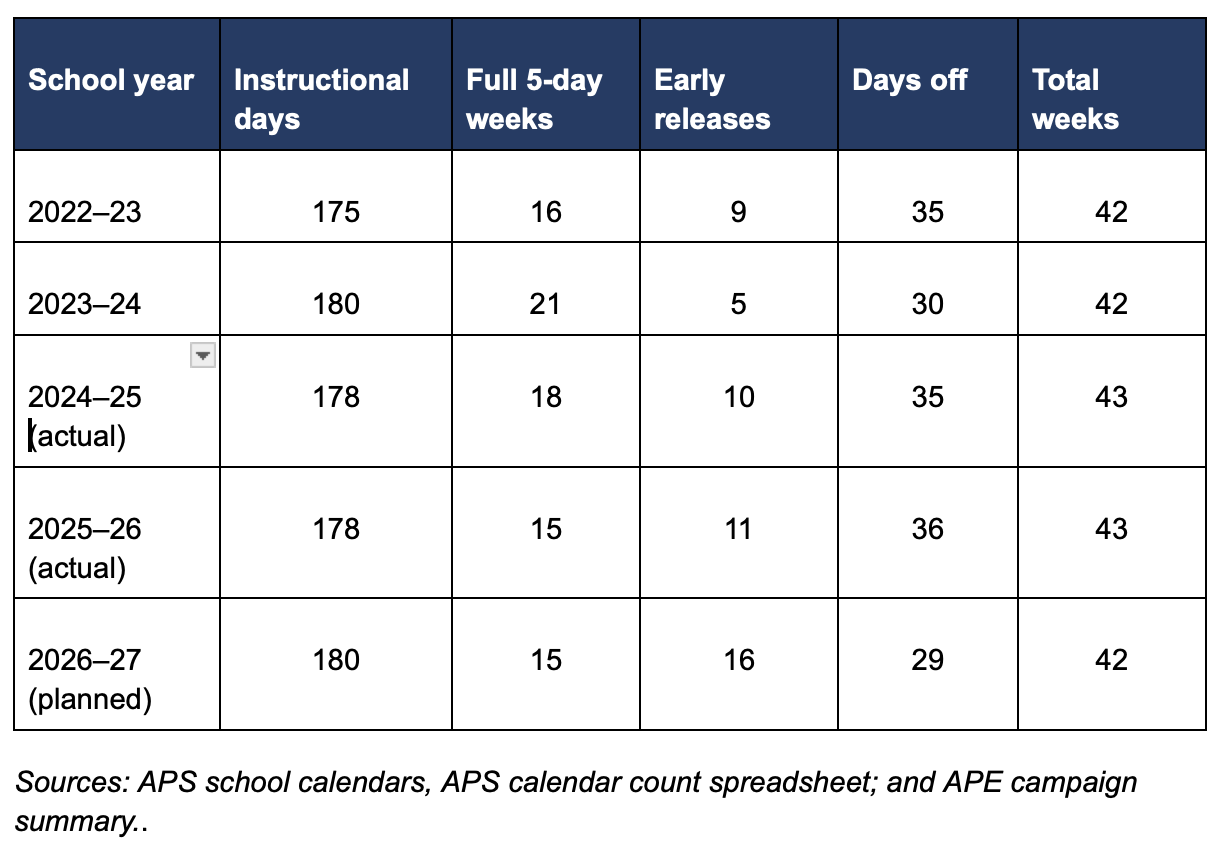
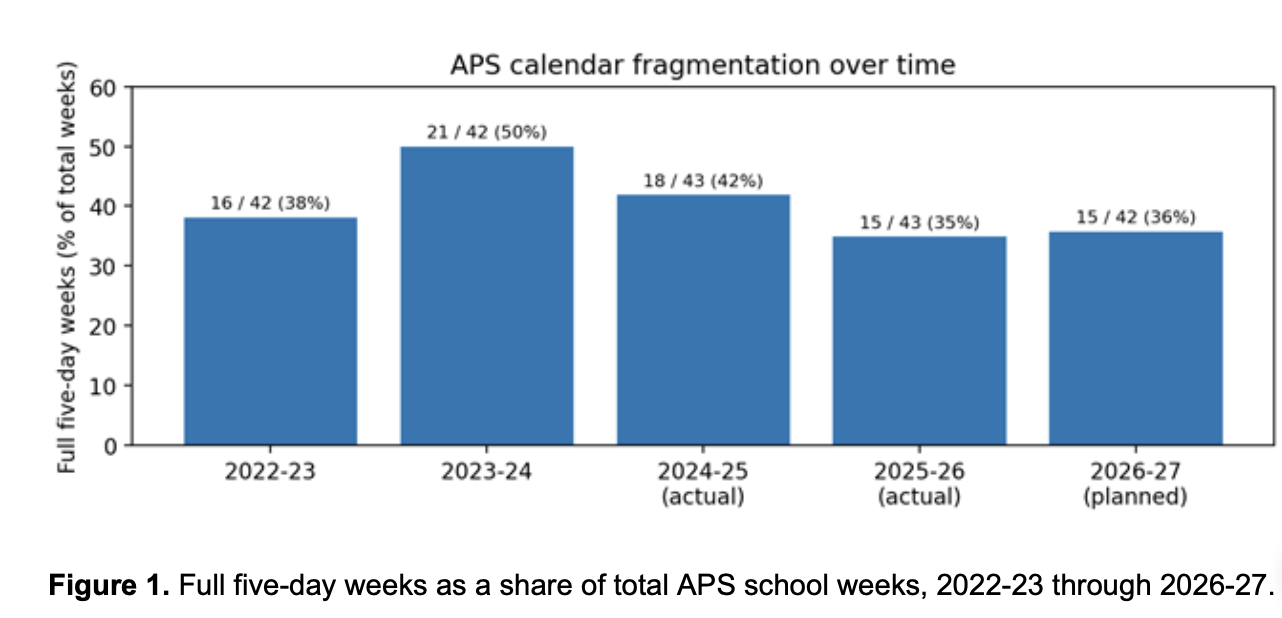
APS calendar counts compiled across recent school years show a clear pattern: instructional days have been reduced from planned totals, early releases have increased, and the share of full five-day weeks has fallen. Using elementary school as the baseline:
APS reduced its count of full five-day weeks from 21 in 2023-24 to 18 in 2024-25 and then only 15 in 2025-26. In SY 2025-26, only 35% of school weeks are full five-day weeks.
APS increased its early release days from 5 in 2023-24 to 10 in 2024-25, 11 in 2025-26, and then up to 16 in the planned 2026-27 calendar.
APS increased its total number of days off from 35 days off in 2024-25 to 36 in 2025-26.
(Sources: APS school calendars, APS calendar count spreadsheet and APE campaign summary.)
2. What 990 hours means in practice
APS’ June 2024 BoardDocs presentation treated its calendar in terms of how many hours exceeded the state’s 990-hour requirement. On the adopted 2024-25 calendar, APS said 180 instructional days translated to 14 inclement-weather days, or 85 instructional hours, above the state’s minimum requirement. After converting two student days to staff professional learning days, APS said the revised 2024-25 calendar would still have 12 inclement-weather days, equal to 73 instructional hours above the state’s floor. That same presentation supports an average instructional day of about 6.07 hours. At 6.07 hours per day, Virginia’s 990-hour floor works out to roughly 163.1 instructional days, not 180.
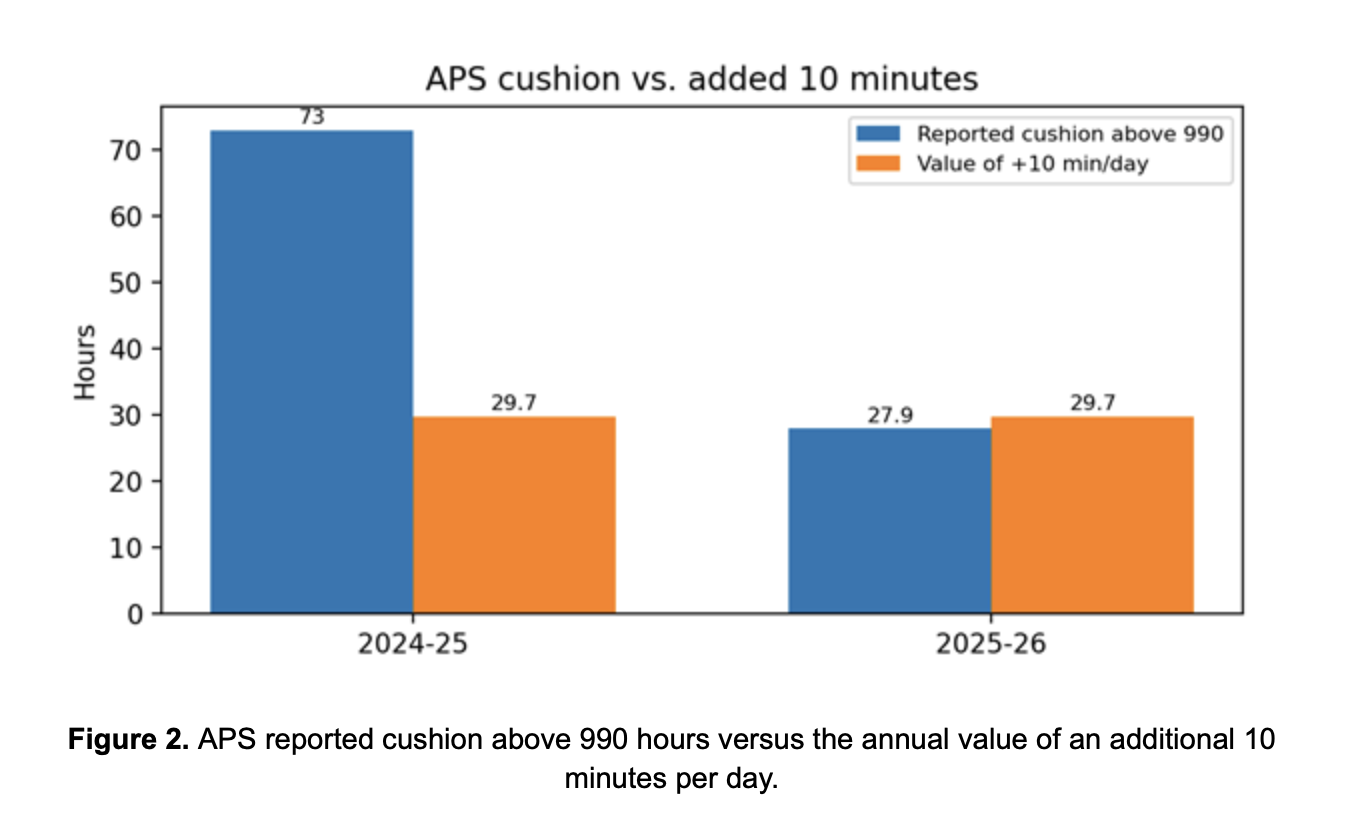
· 2024-25: 178 instructional days; 73 hours above 990; an additional 10 minutes per day contributed about 29.7 hours, or roughly 41% of APS’ cushion.
· 2025-26: 178 instructional days; 27.9 hours above 990 after the year’s changes for snow days and removal of days for voting, etc.; an additional 10 minutes per day again contributed about 29.7 hours.
· Implication: APS moved from using the extra 10 minutes as part of a buffer in 2024-25 to fully depending on those minutes to remain above the state’s 990-hour floor in 2025-26.
3. National context
Pew Research Center found that 180 instructional days is the closest thing the United States has to a national norm: 27 of the 38 states that set a minimum day requirement, plus D.C., require 180 days. Pew also found that states vary widely in annual hour requirements, and that some states allow districts to satisfy minimum requirements through days or annual hours instead of requiring both. For 11th grade, the average annual hour requirement, among the 39 states that specify one, is 1,034.8 hours per year. Virginia’s 990-hour floor sits below that average.
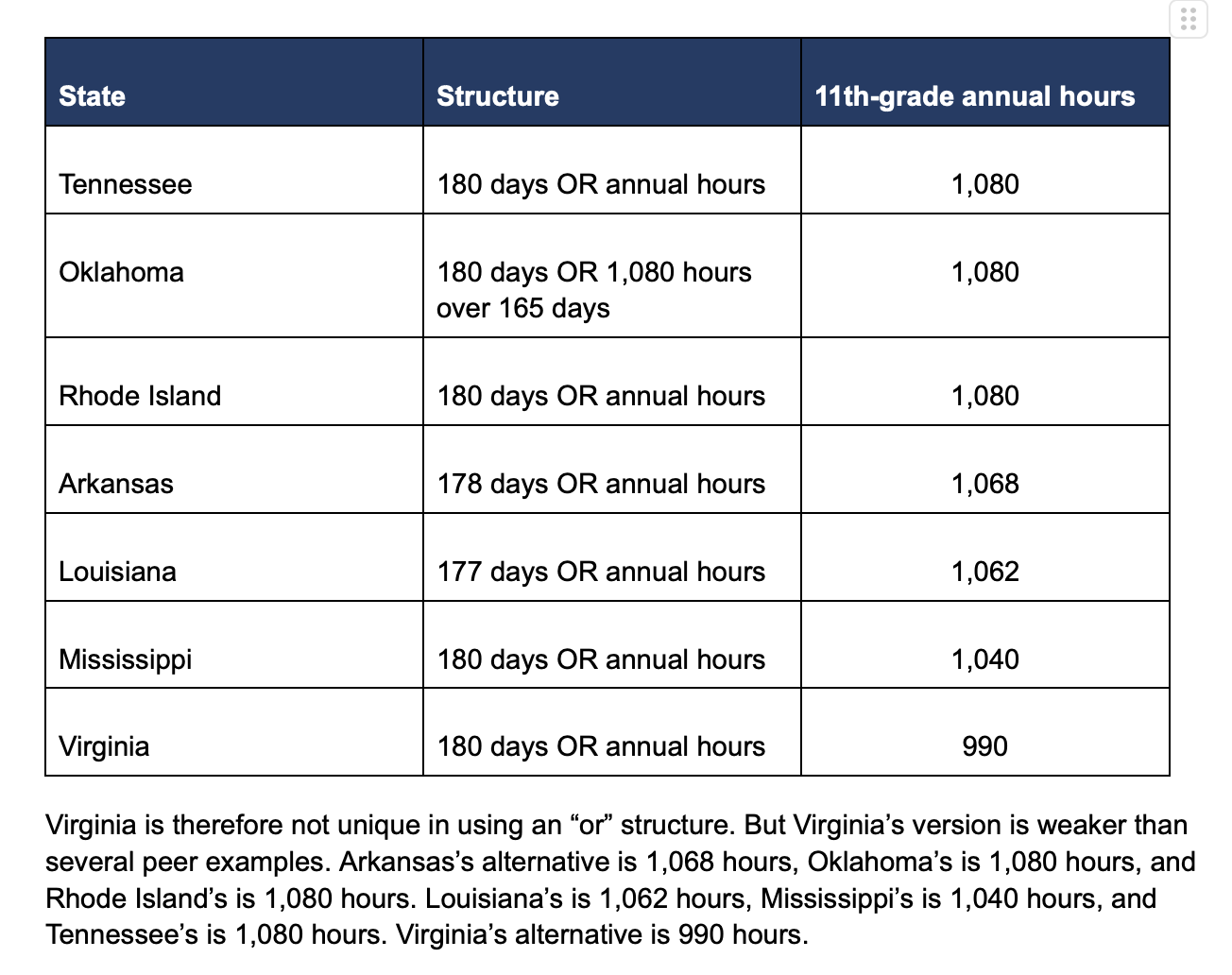
In our view, the “or” is not neutral in Virginia — it effectively lowers the state’s instructional time requirement, as demonstrated by practices in Arlington.
Source notes
· APS calendar count spreadsheet(“Count of APS Calendars”), including annual totals for instructional days, full five-day weeks, early releases, days off, and total weeks.
· APE campaign archive, “Another Day Off: Part of a Broader Pattern,” summarizing APS calendar counts and noting that 2025-26 has 15 full five-day weeks, 11 early releases, 36 days off, and 43 total weeks.
· APS BoardDocs presentation, “Proposed Revisions to the 2024–25 School Year Calendar” (June 20, 2024), including slide 11 (180 instructional days; 14 inclement-weather days; 85 hours above the floor) and slide 12 (revised 2024-25 calendar with 12 inclement-weather days; 73 hours above the floor). (Arlnow coverage)
· Pew Research Center, “In the U.S., 180 days of school is most common, but length of school day varies by state” (Sept. 7, 2023), using Education Commission of the States data. Key points used here: 27 of 38 states with a day requirement, plus D.C., require 180 days; some states allow districts to meet either days or annual hours; the average 11th-grade annual requirement among states that specify one is 1,034.8 hours; Oklahoma’s alternative pathway is 180 days or 1,080 hours over 165 days; Arkansas and Rhode Island also provide alternative structures.